Physical therapy for hockey players in Carmel treats the hip, groin, core, shoulder, knee and ankle injuries the skating stride and body contact produce, and rebuilds the stride power and edge control you need back on the ice. Care is one-on-one with an independent, Indiana-licensed therapist in the network, in a private suite at Carmel City Center, where the indoor turf corridor suits skater drills. Adult league players and parents of youth players are both welcome to ask.
Last reviewed By the Monon Therapy Collective editorial team
- Hot spots
- Hips, groin, lower abdomen, shoulders
- Sports hernia rehab
- Often 4 to 6 weeks of therapy
- Local ice
- Carmel Ice Skadium, Fishers Event Center
- Under 18
- A parent or guardian completes the form
Why does the hockey stride cause so many hip and groin injuries?
The skating stride loads the hips in a deep, flexed position while the leg pushes out to the side and then snaps back in. The adductors, the inner thigh muscles, work hard to control and recover each stride, and the hip joint spends hours near the end of its range. That combination explains why groin strains and hip impingement are so common in hockey.
Shots and quick turns add rotation through the lower abdomen and pelvis. AAOS OrthoInfo lists ice hockey among the sports most linked to sports hernia (athletic pubalgia), a strain of the soft tissues where the abdominal and inner thigh muscles attach near the pubic bone, caused by planting and twisting with maximum effort.
Which injuries do hockey players bring to a physical therapist?
Hip and groin problems lead, followed by shoulder injuries from boards and falls, knee sprains from collisions and edges catching, and high ankle sprains despite the stiff boot. Concussion sits alongside these and always needs a medical evaluation first.
| Injury | How it usually happens in hockey | Read more |
|---|---|---|
| Groin strain | A hard stride or a split when an edge slips | Groin strain |
| Hip impingement | Deep hip flexion in the stride, season after season | Hip impingement |
| Sports hernia | Twisting shots and turns under full effort | Sports hernia |
| AC joint sprain | Driving the shoulder into the boards or the ice | AC joint sprain |
| MCL sprain | A knee-on-knee hit or the skate catching and twisting | MCL sprain |
| High ankle sprain | The foot turned outward when the skate catches a rut | High ankle sprain |
How long does a sports hernia take to settle with physical therapy?
OrthoInfo describes a typical course of 7 to 10 days of rest and ice, then physical therapy to strengthen the abdominal and inner thigh muscles, and notes that in many cases 4 to 6 weeks of therapy resolves the pain and allows return to sport. When pain returns on resuming play, surgery is sometimes considered, with most athletes returning 6 to 12 weeks after the operation.
Diagnosis matters because groin pain in hockey has several possible sources, including the hip joint, the adductor tendon and the abdominal wall, and they can overlap. A therapist tests each in turn, and refers you to a physician if the picture suggests a true inguinal hernia or a hip problem that needs imaging.
Players often try to skate through groin pain for weeks before getting it checked, which can turn a simple adductor strain into a longer problem. Getting it examined early, before the pain changes your stride, usually shortens the time away from the ice.
What does skater-specific rehab look like off the ice?
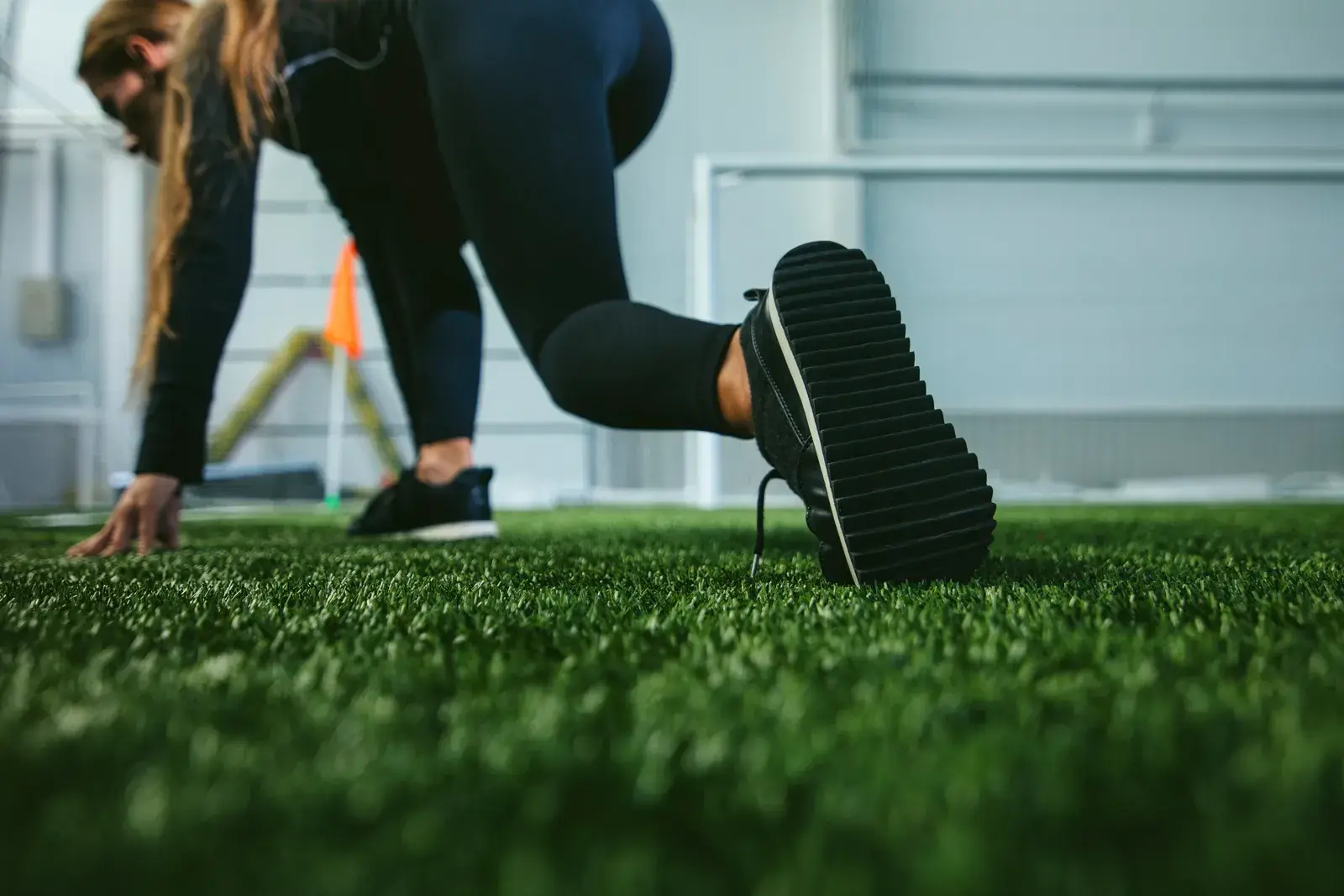
Skater-specific rehab trains the stride’s shapes and speeds before you go back on the ice. The indoor turf corridor outside the suites allows lateral bounds, slide-board style work on a towel, crossovers walked and then hopped, and short accelerations, all progressed as the injured area tolerates them.
Adductor strength is a priority because it protects the groin. The Copenhagen plank is a well-known example, built up from short-lever versions. Hip mobility, single-leg strength on the rack, rotational work on the cable system for shooting, and shoulder stability for contact complete the picture. The last step is a gradual on-ice return, from easy skating to practice to games.
- Calm the injury and restore hip and groin movement
- Build adductor, hip and core strength
- Add lateral bounds, crossovers and accelerations on turf
- Return to ice for skating only, then puck work, then contact
- Pass agreed strength and agility checks before games
Where do hockey players around Carmel skate, and how does that shape rehab?
Carmel Ice Skadium runs an adult hockey league, open hockey, stick and puck sessions and clinics, and the Fishers Event Center hosts the Indy Fuel. That means many local players skate late in the evening or early on weekends, and rehab sessions are easiest to schedule around those ice times.
Suites are open from 5 AM to 9 PM on weekdays and 7 AM to 4 PM on weekends, with each independent therapist setting their own hours inside them. Open hockey and stick and puck sessions make a useful bridge back to full play, since you can skate without contact or game pressure. Equipment fit is worth a look during rehab too: skates that are worn out or sharpened differently can change how the hips and groin load, and a shoulder injury may call for checking pad fit before contact returns. Before games, many players work through return-to-sport testing to check strength and agility against the uninjured side.
Get medical care first if
Some hockey injuries need a physician or emergency care before rehab.
- Any head hit with confusion, vomiting, worsening headache or memory loss
- A shoulder that looks out of place or a collarbone with a bump
- A cut from a skate blade, especially near the wrist, thigh or ankle
- A bulge in the groin that grows with coughing
- A knee that swelled quickly or locks
If you think it is an emergency, call 911.
