Knee pain when straightening the leg usually comes from the front of the knee, the tendon below or above the kneecap or the fat pad beneath it, or from a joint that has lost its last few degrees of extension because of arthritis, swelling or a meniscus tear. A knee that suddenly locks and cannot straighten, or cannot be lifted straight at all after a fall, needs a physician first. For gradual pain, an Indiana-licensed physical therapist near Carmel can assess the knee without a referral.
Last reviewed By the Monon Therapy Collective editorial team
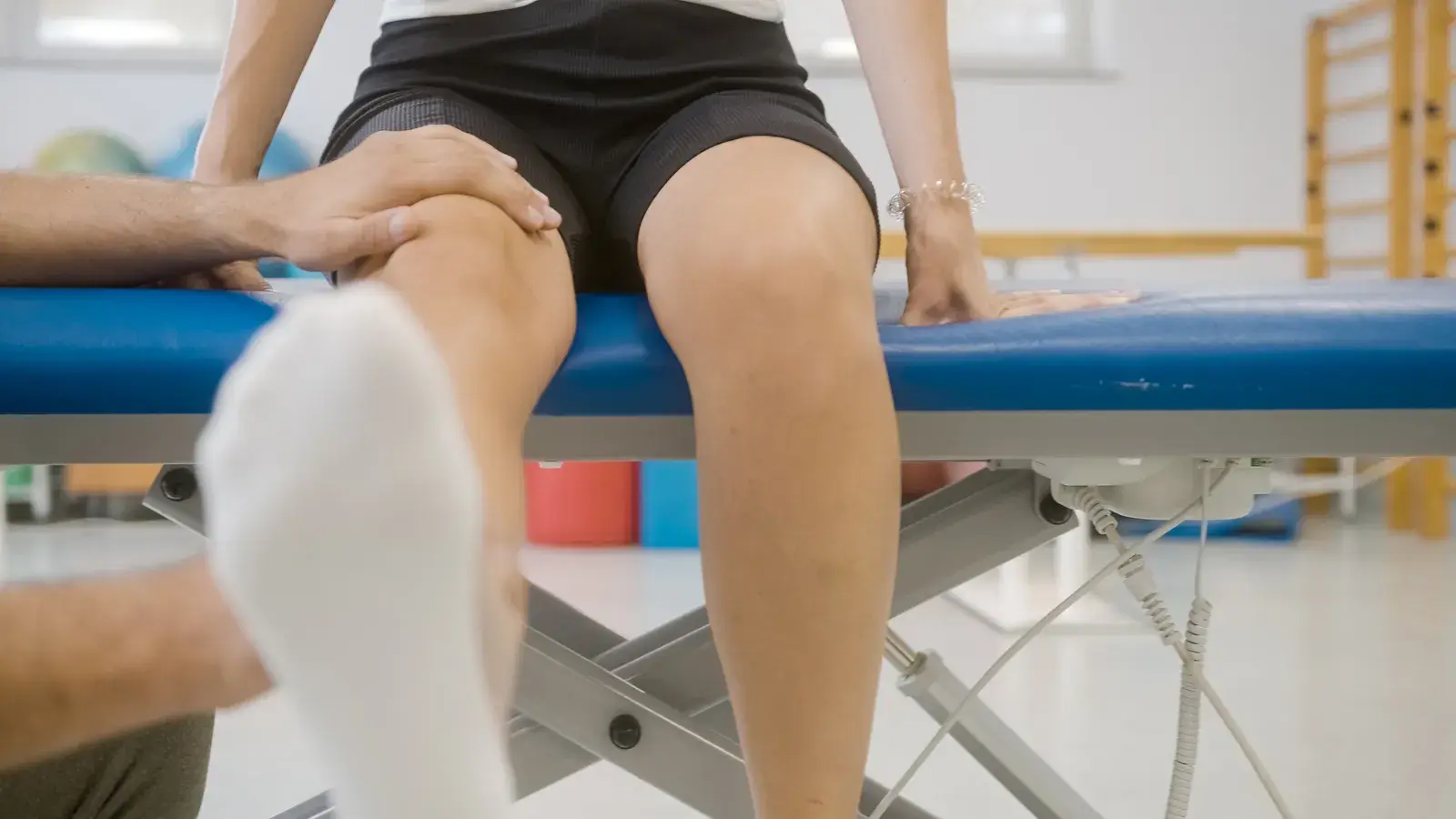
Can I not straighten it, or does it just hurt to?
This distinction changes everything, so test it first. Sit with the leg out on a bed. If you can push the knee flat with a hand or let gravity straighten it, but it hurts to do so with your own muscles, the joint moves and the problem is more likely tendon or kneecap irritation. If the knee is blocked short of straight no matter how you position it, something is limiting the joint itself.
A third pattern matters most: being unable to lift the straight leg off the bed at all after a fall or a hard landing, sometimes with a dip in the skin just below the kneecap. AAOS OrthoInfo describes an indentation at the bottom of the kneecap and an inability to straighten the knee as signs of a torn patellar tendon, which does better with early surgical repair.
What causes pain at the end of knee extension?
End-range pain usually comes from structures at the front of the knee being pinched or loaded, or from a joint that has quietly lost range. The causes below are the ones a therapist screens most often.
| Likely cause | What it tends to feel like | Read more |
|---|---|---|
| Patellar tendinopathy | Sore spot just below the kneecap, worse kicking, jumping or straightening against resistance | Patellar tendinitis |
| Quadriceps tendinopathy | Ache just above the kneecap when the thigh muscle contracts hard | Quad tendinitis |
| Meniscus tear | Joint-line pain, catching, or a block that stops the knee going fully straight | Meniscus tear |
| Knee osteoarthritis | Gradual loss of the last few degrees, stiffness after rest, a slight bent-knee walk | Knee osteoarthritis |
| Baker’s cyst | Tightness or fullness behind the knee that increases as the leg straightens | Baker’s cyst |
| Irritated fat pad below the kneecap | Puffy, tender area either side of the tendon, worst when the knee snaps straight or locks back while standing | Knee pain |
Why does a few degrees of lost straightening matter so much?
A knee that stops even a little short of straight makes the thigh muscles work during every step, because the leg can no longer rest on a locked-out joint while you stand. That extra effort tires the quadriceps, loads the kneecap and can produce a limp, which is why therapists treat full extension as a priority after injuries and operations.
Lost extension is especially common after ACL reconstruction and knee replacement, and both rehab guides, ACL reconstruction rehab and total knee replacement rehab, treat it as an early milestone. When stiffness persists despite good rehab, a surgeon may discuss a procedure, covered in knee manipulation under anesthesia rehab.
How does a therapist measure and treat knee extension?
A therapist measures extension with a goniometer, a hinged ruler, and often compares heel height with you lying face down and both legs hanging off the table; a difference of a few centimeters reveals small losses the eye misses. They check for a quad lag, where the knee can be straightened by hand but not by the muscle, and test the tendon, joint line and kneecap mobility.
Treatment depends on the cause. Tendon pain is usually managed with staged loading such as slow leg extensions and holds. A stiff joint may need regular low-load stretching into extension, patellar mobility work and quadriceps activation; the terminal knee extension exercise is one that people commonly meet in this phase, with your therapist setting the dose.
What can I try at home if straightening hurts?
Avoid standing with the knee forced back into a locked position for long periods, and break up long sits with a short walk, since both can aggravate the front of the knee. Short, frequent bouts of gentle movement through the comfortable range usually beat one long stretching session.
If you can tolerate it, sit with the heel resting on a stool and the knee unsupported for a minute or two, letting gravity coax the last bit of straightening, and stop if it becomes sharp. If the pain is lasting beyond a couple of weeks, the knee questionnaire reaches the matching team, who propose a therapist in the network.
See a physician first if
- The knee suddenly locked and cannot be straightened, even with help
- You cannot lift your straight leg off the bed after a fall or landing
- There is a visible gap or dent just below or above the kneecap
- The knee is hot, red and swollen with a fever
If you think it is an emergency, call 911.
