Groin pain that comes on as you walk most often starts in the hip joint itself, as with hip osteoarthritis or hip impingement, or in a strained adductor (inner thigh) muscle. Less often it is a sports hernia, a stress fracture, a true hernia or pain referred from the spine. A physical therapist separates these with hands-on tests such as a squeeze test with a ball between the knees. Indiana’s direct access rule lets you start with a physical therapist, no referral needed, for up to 42 calendar days.
Last reviewed By the Monon Therapy Collective editorial team
- Commonest joint source
- Hip osteoarthritis, which usually hurts in the groin
- Commonest muscle source
- Adductor or hip flexor strain
- See a doctor first
- A groin bulge, fever, or being unable to bear weight
- Referral in Indiana
- Not needed for the first 42 calendar days
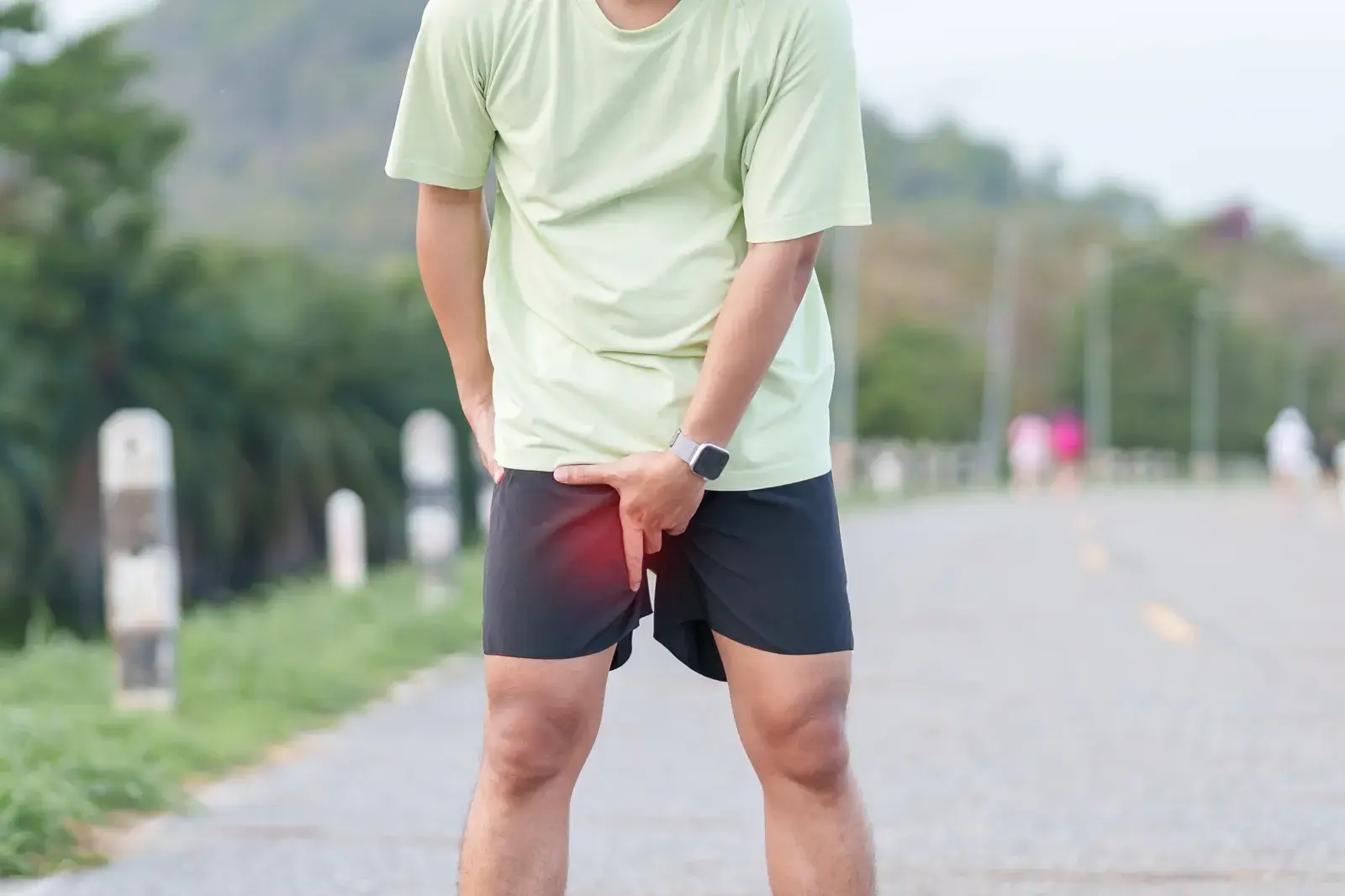
Which hip and groin problems hurt most when you walk?
The usual suspects are the hip joint (osteoarthritis, impingement or a labral tear) and the muscles that cross the front and inside of the hip (adductor and hip flexor strains). OrthoInfo, the patient site of the American Academy of Orthopaedic Surgeons, lists the groin as the most common place people feel hip osteoarthritis, which surprises many people who expect it on the side of the hip.
The way the pain behaves narrows the list. Joint pain tends to be deep, hard to point at with one finger, and stiff after sitting. Muscle and tendon pain usually sits on a spot you can press, near the pubic bone or the crease at the front of the hip.
| Likely cause | What it tends to feel like | Where to read more |
|---|---|---|
| Hip osteoarthritis | Deep groin ache, stiffness after sitting or in the morning, a limp on longer walks, sometimes pain spreading to the thigh or knee | Hip osteoarthritis |
| Hip impingement or labral tear | A sharp pinch in the groin when you turn, twist or squat, sometimes a catch or click; long strides and hills can provoke it | Hip impingement |
| Adductor (groin) strain | Pain on the inner thigh near the pubic bone, worse with long strides, side steps and swinging the leg out of a car | Groin strain |
| Hip flexor strain | Upper groin and front-of-hip pain when you lift the knee, climb stairs or step onto a curb | Hip flexor strain |
| Sports hernia (athletic pubalgia) | Lower belly and groin pain with twisting and kicking that eases with rest; no visible bulge | Sports hernia |
| Stress fracture of the femoral neck or pubic bone | A groin ache that builds with every walk or run, lingers afterward and often follows a jump in mileage | Stress fracture |
How can I tell if groin pain is the hip joint or a pulled muscle?
A few simple observations point one way or the other, though none of them is a diagnosis. Joint problems usually limit rotation and feel deep; muscle strains hurt when the muscle contracts hard or is stretched, and are tender on one spot.
Try these gently and stop if anything is sharp. Write down what you notice and bring it to your first visit, because the pattern over a week tells a therapist more than one bad afternoon.
- Sit and rest the ankle of the sore leg on the opposite knee. A deep pinch in the groin, rather than a stretch on the inner thigh, leans toward the joint.
- Lie on your back with knees bent and squeeze a pillow between them. Pain near the pubic bone leans toward the adductors.
- Notice timing: stiff for the first few minutes and then easier suggests arthritis; pain that grows with distance and aches afterward needs a check for a stress fracture.
- Stand and cough while looking at the groin. Any bulge belongs with a physician, not an exercise plan.
What does a physical therapist test when your groin hurts to walk?
Your therapist watches you walk first, looking at stride length, a limp or a lean of the trunk over the sore hip, then compares hip rotation side to side. Loss of inward rotation with groin pain at the end of the range is a common joint pattern.
Next come provocation tests. The squeeze test places a ball or folded cuff between your knees and asks you to press: pain at the pubic bone or the adductor tendon points to the groin muscles. A test that bends the hip and turns it inward, toward the opposite shoulder, can reproduce impingement pain. The therapist also presses along the adductor tendon, the pubic bone and the lower belly, and screens the lower back, since a lumbar disc can refer pain to the groin. A tender abdomen, a bulge or a pattern that fits a stress fracture is referred to a physician for imaging.
How do I keep walking while groin pain settles?
Keep walking, but change the walk. Shorter strides, flatter routes and two short outings instead of one long one usually let the tissue calm down without losing fitness. The paved Monon Trail through Carmel is an easy place to control distance, because you can turn around at any cross street.
Strength is what changes the picture over weeks. A therapist commonly starts with low-load adductor squeezes and bridges, then progresses to side-lying work and, for athletes, the Copenhagen plank. For hip osteoarthritis the focus shifts to hip strength, walking tolerance and range of motion. OrthoInfo says 4 to 6 weeks of physical therapy often settles sports hernia pain enough to return to sport, and that pain which comes back on resuming sport may need surgery. Pickleball players should drop the long lateral lunge for now rather than playing through it.
How do I get matched with a therapist for groin pain near Carmel?
Fill in the two-minute hip and groin questionnaire, mention when the pain started and what makes it worse, and a person on the matching team reads it. They propose an independent, Indiana-licensed physical therapist whose focus and schedule fit and pass you to that therapist’s office, which confirms benefits and books the first visit.
Sessions are one-on-one in private suites at Carmel City Center, open from 5 AM on weekdays, with garage parking a short walk away. If your groin pain sits mainly at the front of the hip crease, the guide to pain in the front of the hip covers that pattern in more detail.
When groin pain needs a doctor first
Call your doctor, use urgent care, or call 911 if you notice:
- A painful groin or scrotal bulge that will not go back in, especially with nausea or vomiting
- Sudden, severe testicular pain or swelling
- Groin pain with fever, burning when you urinate or blood in the urine
- Pain after a fall, or you cannot put weight on the leg
- A deep ache that worsens with each walk or run and aches at night after a training increase
If you think it is an emergency, call 911.
