Elbow pain when you grip, lift a mug or shake hands most often comes from the forearm tendons that attach at the elbow: tennis elbow on the outside, golfer’s elbow on the inside. OrthoInfo lists weak grip as a common sign of both and reports that most people with tennis elbow improve without surgery. Tingling into the ring and little fingers points instead to the ulnar nerve. A physical therapist locates the source, measures grip strength and builds a gradual tendon loading plan around your work and sport.
Last reviewed By the Monon Therapy Collective editorial team
- Outside of the elbow
- Usually tennis elbow (lateral epicondylitis)
- Inside of the elbow
- Usually golfer’s elbow (medial epicondylitis)
- Typical age for tennis elbow
- OrthoInfo: most people are 30 to 50
- Nonsurgical success
- OrthoInfo: about 80 to 95 percent for tennis elbow
Is my grip pain on the outside or inside of the elbow?
Point to the sorest spot with one finger, because the side tells you a lot. The outside bony bump anchors the tendons that lift the wrist and fingers, so gripping hard while the wrist is cocked back, like lifting a pan or turning a wrench, loads it. The inside bump anchors the tendons that bend the wrist and turn the palm down, which work hard in golf swings, throwing and carrying.
OrthoInfo notes tennis elbow is common in painters, plumbers, carpenters, cooks and butchers, not just tennis players, and that golfer’s elbow also follows throwing, tennis and weightlifting. Pickleball players often notice it after a jump in play time during the long outdoor season.
| Likely cause | What it tends to feel like | Where to read more |
|---|---|---|
| Tennis elbow (lateral epicondylitis) | Pain on the outside bump with gripping, lifting with the palm down, shaking hands; weak grip | Tennis elbow |
| Golfer’s elbow (medial epicondylitis) | Pain or burning on the inside bump, sometimes shooting toward the hand; weak grip | Golfer’s elbow |
| Ulnar nerve irritation (cubital tunnel) | Tingling or numbness in the ring and little fingers, worse with the elbow bent for long | Cubital tunnel syndrome |
| Wrist tendinitis | Pain nearer the wrist than the elbow, often at the thumb side with pinching | Wrist tendinitis |
| Repetitive strain from tools or keyboards | Diffuse forearm ache that builds over a work week | Repetitive strain injury |
Why is my grip weaker when my elbow hurts?
Grip feels weak mostly because the brain limits force when the tendon hurts, not because the muscle has wasted. That is also why grip usually recovers as the tendon calms, well before a muscle could have rebuilt itself.
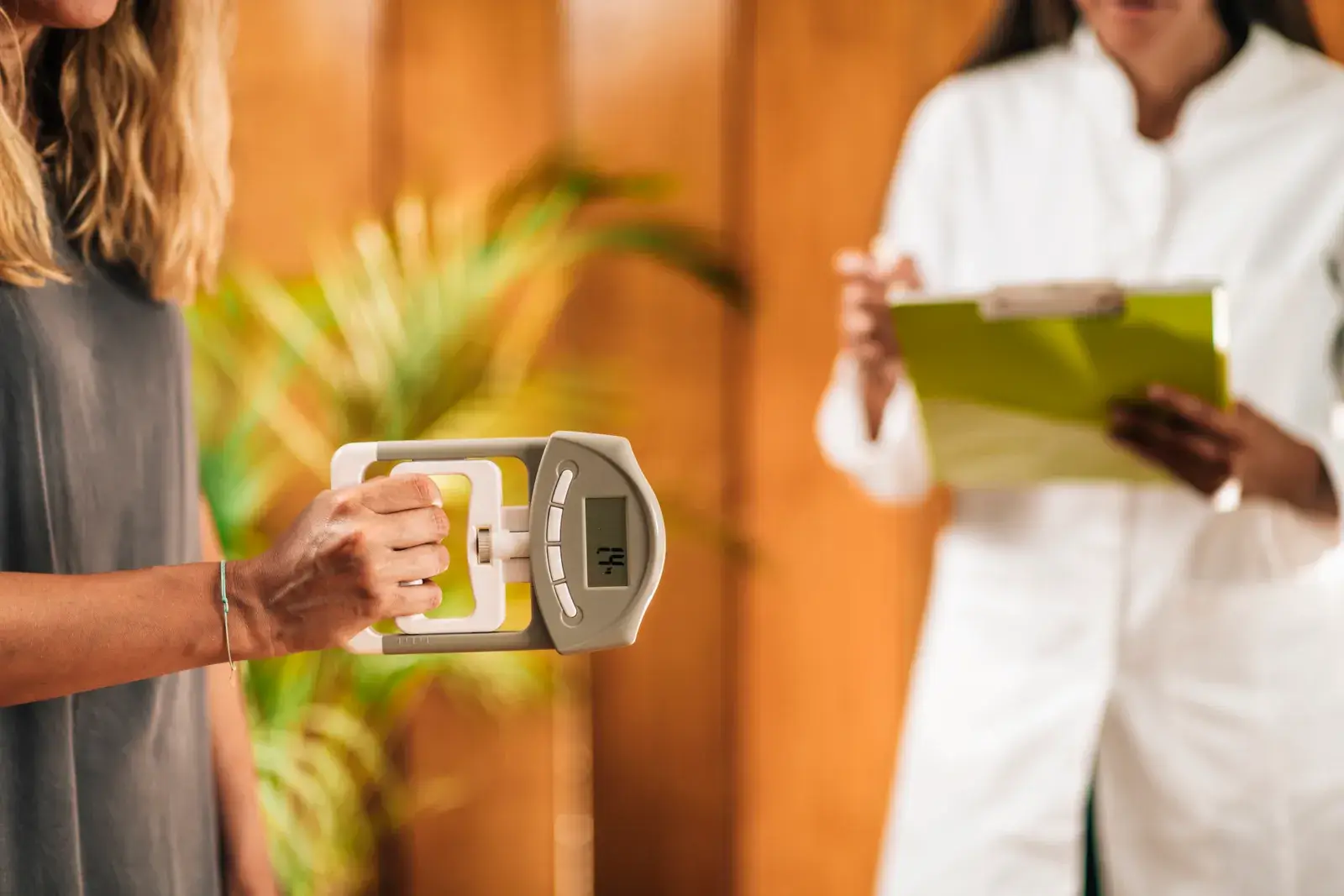
A therapist usually tests pain-free grip with a handheld dynamometer, a squeeze gauge that reads in pounds or kilograms. You squeeze until the first hint of pain, and the number is compared with your other hand. Repeating it every few weeks gives an objective measure of progress, which is more reliable than how a single day feels.
What else does a therapist check when gripping hurts the elbow?
Beyond pressing on the tendons, the therapist tests resisted wrist and middle finger lifting (which loads the outer tendons) and resisted wrist bending and palm turning (the inner ones). Nerve tests include tapping behind the inner bump and holding the elbow fully bent to see whether finger tingling appears.
The neck is screened too, since a pinched nerve in the neck can refer pain into the forearm. Finally the therapist asks about your hours on a mouse, tools you use, racket or paddle grip size and string tension, and how quickly training or work volume rose.
Which exercises and changes help grip pain at the elbow?
Gradual tendon loading is the core. Plans commonly start with gentle isometric holds and progress to slow lowering exercises such as the wrist extensor eccentric, then to strength through the shoulder and forearm. Your therapist sets the load and the acceptable pain level, which is usually mild and settled by the next morning.
Meanwhile, change the grip demand: lift with the palm up instead of down, use thicker handles on tools, choose a slightly larger racket or paddle grip, and spread heavy work over the day. A counterforce strap can make work tolerable for some people. Golfers and pickleball players will find sport-specific detail on the pages for golfers and pickleball players.
How long does elbow pain from gripping usually take to improve?
Tendon pain at the elbow commonly takes several months to settle fully, and occasionally longer. OrthoInfo reports that roughly 80 to 95 percent of people with tennis elbow have success with nonsurgical treatment; how long tennis elbow lasts explains the usual course.
Starting sooner and keeping the load right shortens the frustrating middle months. Choose “elbow, wrist and hand” on the questionnaire; the matching team proposes an independent therapist in the network, and the therapist’s office confirms your coverage before booking.
When elbow pain needs a physician
See a doctor promptly if you have:
- A pop at the front of the elbow with a bulge or bruise in the upper arm
- Elbow pain after a fall, especially if you cannot fully straighten or bend it
- A hot, red, swollen elbow or fever
- Weakness or wasting of the small hand muscles, or numbness that keeps spreading
If you think it is an emergency, call 911.
