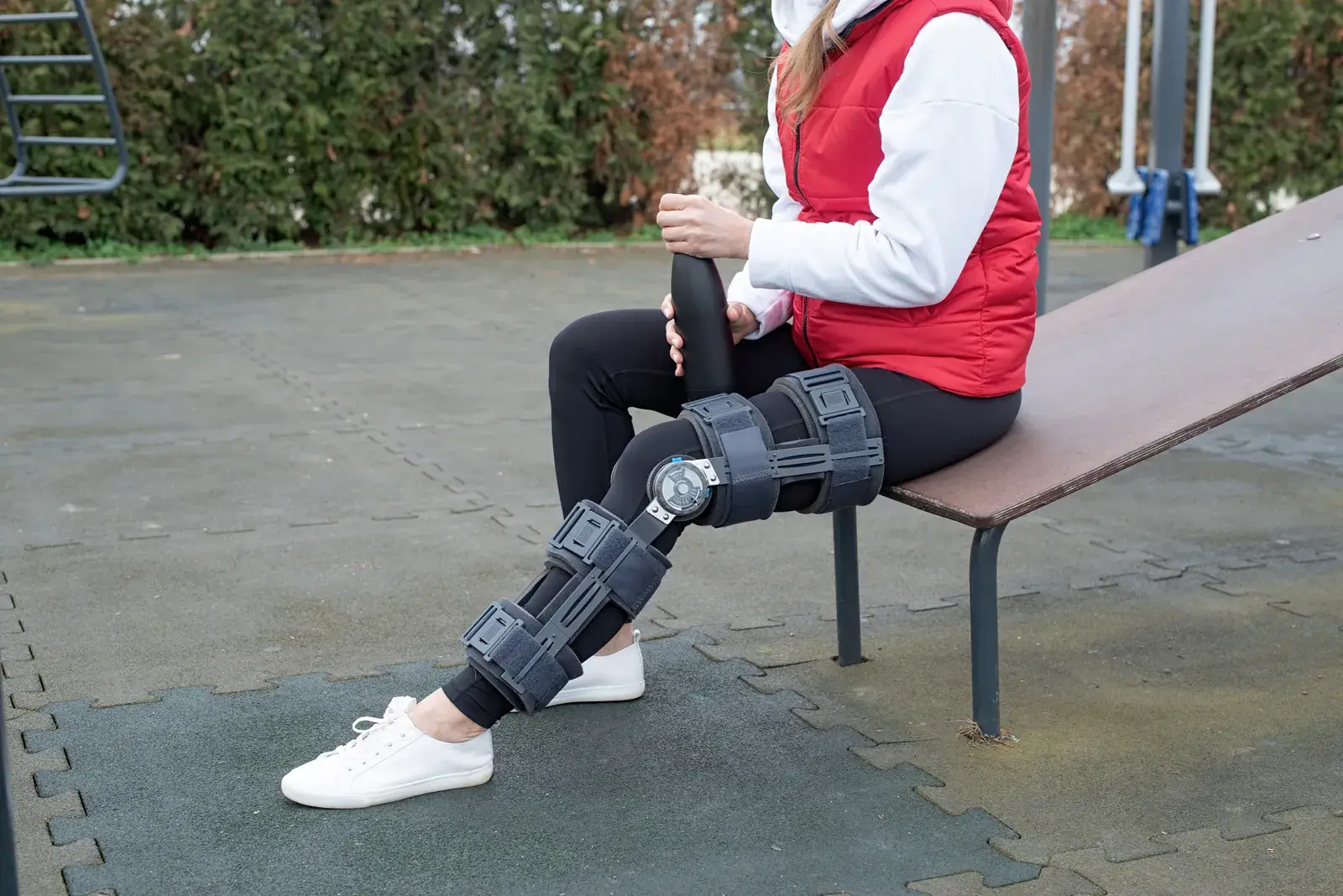
Rehab after a tibial plateau fracture, a break in the top of the shinbone that forms the lower half of the knee joint, combines two things that feel contradictory: moving the knee early to prevent stiffness while keeping weight off the leg until the bone heals. OrthoInfo notes full weight bearing may take as much as three months or more, with crutches, a walker or a wheelchair and sometimes a hinged brace in the meantime. Near Carmel, the matching team can suggest an independent, Indiana-licensed physical therapist in the network who works one-on-one in a private suite and follows your surgeon’s plan.
Last reviewed By the Monon Therapy Collective editorial team
- Full weight bearing
- Often 3 months or more
- Early motion
- Therapist-assisted or a passive motion machine
- Walking aids
- Crutches, walker or wheelchair; often a hinged brace
- Long-term risks
- Stiffness, instability, later arthritis
Why bend the knee early but keep weight off it after a plateau fracture?
The fracture runs into the joint surface, so loading it before it heals can push the pieces down and leave a step in the cartilage, while keeping the knee still invites lasting stiffness. The answer is early motion without weight: OrthoInfo describes a therapist moving the knee gently or a continuous passive motion machine doing it for you.
That means weeks of exercises that bend and straighten the knee while you lie, sit or ride a bike with no resistance, alongside quadriceps activation, and getting around on crutches, a walker or a wheelchair. A hinged brace, if used, lets the knee move within limits while protecting it from sideways stress.
What are the stages after a tibial plateau fracture, week by week?
Timelines depend on the fracture pattern, the fixation and bone quality, and progress is guided by X-rays. OrthoInfo notes that fractures in many pieces or in weaker bone may take longer to heal.
| Time after injury or surgery | Main goals | Typical milestones |
|---|---|---|
| 0 to 6 weeks | Protect the joint surface, control swelling, recover motion | No or touch-down weight; passive and assisted bending; quadriceps sets |
| About 6 to 12 weeks | Keep building motion, begin partial weight if X-rays allow | Bike with full turns; weight added in steps per the surgeon |
| About 3 to 4 months | Full weight, normal walking, strength | Off crutches; sit-to-stand, step-ups, leg press |
| 4 to 12 months | Endurance, stairs, return to work and recreation | Longer walks, kneeling trial, sport only if the surgeon clears it |
Which limits on weight and bending does the trauma surgeon control?
The surgeon controls when and how much weight you may put on the leg, the brace settings, any bending limit, and when you may drive, because those depend on how the joint surface was restored and how secure the fixation is. Changes are usually made after a follow-up X-ray, not on a set day.
Your therapist controls how to recover motion and strength inside those limits, and is often the first to notice a problem: a knee that stops gaining bend, swelling that will not settle, or a new feeling of looseness. Those are reported to the surgeon rather than pushed through.
How do you stay strong during months off the leg?
You stay strong by training everything that is allowed: the hip and core lying down and sitting, the quadriceps with isometric contractions, the opposite leg, and the upper body, which does extra work on crutches. A therapist builds a program so the operated leg is not the only thing that has weakened by the time weight bearing starts.
In a private suite with a bench, cable system and dumbbells, seated and lying exercises can be loaded properly without standing on the leg. Swelling control matters too: elevation, compression and gentle ankle pumps help the calf move fluid while you are less active.
- Quadriceps sets and straight-leg raises within the brace rules
- Hip strength lying on the back and side
- Upper body pushing and pulling to manage crutches
- Ankle pumps and elevation for swelling
What does relearning to walk look like after a plateau fracture?
Once weight is allowed, walking is rebuilt in steps: partial weight on crutches, then one crutch or a cane, then no aid, with attention to a full knee straightening at heel strike and an even stride. Many people unconsciously keep the knee slightly bent, which a therapist corrects early.
Stairs, curbs, slopes and getting up from the floor come next, and the gait training page explains the approach. The Monon Trail’s flat, paved surface is a common first outdoor route, and the indoor turf corridor outside the suites offers a softer surface for practice in winter.
How do you manage a home on crutches with no weight on one leg?
Plan the home around one floor if you can for the first weeks: a bed, a bathroom and a chair with arms within easy reach, rugs and cords cleared, and night lights on the route to the bathroom. A shower chair, a raised toilet seat and a small bag or apron for carrying things free up both hands for the crutches or walker.
Stairs with no weight on one leg follow a fixed pattern: up with the good leg first, down with the crutches and injured leg first. A therapist will rehearse this with you, check the height of your crutches or walker, and decide whether a wheelchair is safer for longer distances. Ice in a Carmel winter makes outdoor paths risky on crutches, so a ride to the garage door is worth arranging.
- Bed, bathroom and chair on one level
- Rugs and cords cleared, night lights on
- Shower chair and raised toilet seat
- Up with the good leg, down with the injured leg
Why does arthritis come up in conversations about plateau fractures?
Because the break involves the cartilage surface of the knee, OrthoInfo lists long-term arthritis, along with loss of motion and stability, among the possible consequences. That does not mean it is inevitable, but it is a reason to keep the thigh strong and your weight manageable long after the bone heals.
If knee wear develops later, the knee osteoarthritis physical therapy page covers what helps. Because these fractures are injuries, there is rarely time for prehab; the most useful early step is setting up the home for weeks on crutches or a walker.
How do I arrange plateau fracture rehab near Carmel?
Complete the physical therapy questionnaire, choose after surgery or injury, and note your weight-bearing status and brace. A person on the matching team suggests a therapist in the network, and that therapist’s office checks benefits and books.
Garage parking at Carmel City Center is a short walk from the suites; if you are on a walker or in a wheelchair, say so on the form so arrival can be planned before your first visit.
Get help promptly after a tibial plateau fracture if
- Severe, increasing pain in the leg with tightness, numbness or pain on moving the toes: go to an emergency department (possible compartment syndrome)
- Calf pain, swelling or warmth in either leg
- Chest pain or shortness of breath: call 911
- Fever, or a wound that is red, hot or draining
- A fall onto the leg, or a new feeling that the knee is giving way
If you think it is an emergency, call 911.
