When a cast or splint comes off, most people find a stiff joint, a thinner muscle and a limb that feels fragile, even though the bone has healed enough for the doctor to remove the support. Physical therapy after a fracture restores motion first, then strength and confidence, with loading paced to what the healing bone can take. For people in and around Carmel, the matching team reads your questionnaire and suggests an independent, licensed therapist whose schedule and focus fit the fracture you are recovering from.
Last reviewed By the Monon Therapy Collective editorial team
- Bone healing
- Several weeks to several months (AAOS)
- Pain versus strength
- Pain usually fades before bone is fully solid
- Common after a cast
- Stiffness, muscle loss, swelling, dry skin
- Who sets loading
- The doctor treating the fracture
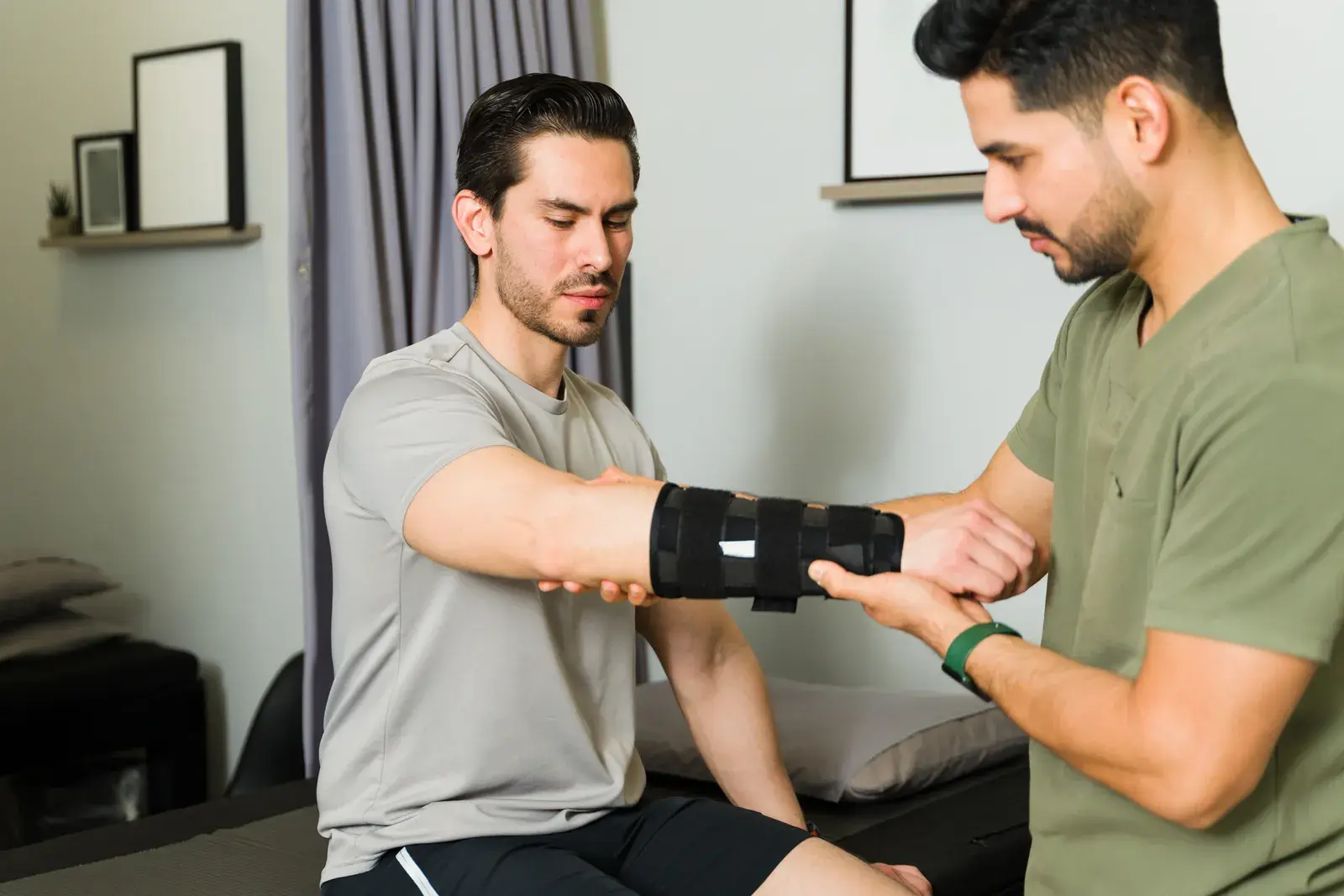
Why does a limb feel so weak and stiff when the cast comes off?
It feels weak and stiff because the joints above and below the break have been held still for weeks, and muscles shrink quickly when they are not used. OrthoInfo notes that stiffness and weakened muscles are common during fracture recovery, and that prescribed exercise is what restores motion, strength and flexibility.
The skin often looks dry and flaky, the limb may be thinner, and swelling can appear once you start using it again, especially in a hand or foot that hangs down. None of that usually means anything has gone wrong. It reflects the time in the cast more than the injury itself.
The surprising part for many people is pain. OrthoInfo points out that pain usually stops long before the bone is solid enough for everyday stresses. That is why feeling fine is not the same as being ready to lift, run or fall on it, and why your doctor’s loading guidance still matters after the cast is off.
What does rehab look like in the weeks after a cast or splint is removed?
Rehab moves through restoring motion, then strength, then the specific tasks of your life or sport. The pacing depends on which bone broke, whether surgery was needed, your age and bone health, and what your doctor allows, so read this as a general pattern rather than a schedule.
| Time out of the cast | Goals | Typical milestones |
|---|---|---|
| First 2 weeks | Regain motion, calm swelling, rebuild daily use | Gentle active movement several times a day; skin care; light tasks with the limb |
| 2 to 6 weeks | Start strengthening, normalize walking or reaching | Bands, light weights or body weight; balance work after a leg fracture |
| 6 to 12 weeks | Restore strength close to the other side | Progressive loading; stairs, carrying, gripping or pushing as relevant |
| 3 months and beyond | Impact, sport and heavy work | Running, jumping, contact or manual labor only after the treating doctor clears it |
How does fracture rehab change depending on which bone broke?
The principles stay the same, but the priorities shift with the bone. An arm fracture is usually rehabbed around reaching, gripping and turning the forearm; a leg fracture around walking without a limp, stairs and balance; a spine or pelvis fracture around posture, walking tolerance and bone health.
Fractures that extend into a joint, need plates or screws, or happen in older bones often take longer. Some have their own pages here because their rehab has specific rules: a broken wrist after surgery, a broken collarbone, an ankle fracture fixed with surgery, and a fractured hip.
Stress fractures are different again. They come from repeated load rather than one fall, so the rehab includes looking at training volume, footwear and recovery, which our stress fracture page covers.
What does a first therapy visit after a cast actually measure?
It measures how far the stiff joints move, how strong the muscles around the fracture are compared with the other side, how much swelling there is, and how well you manage the everyday tasks the injury has interrupted. Those numbers become the starting line for your plan and for the conversation with the doctor treating the fracture.
Expect the therapist to ask how the break happened, how it was treated, what your doctor said about loading, and what you most need back: typing, carrying a toddler, climbing the stairs at home, a Saturday round of golf. The examination might include a goniometer (a hinged ruler for joint angles), a grip gauge after an arm fracture, or a timed walk and balance test after a leg fracture.
You should leave with a short home program you can do several times a day, a clear idea of which activities are fine now and which should wait, and an honest estimate of the weeks ahead. Our guide to the first physical therapy visit explains how that appointment usually runs.
- Joint motion above and below the break
- Strength compared side to side
- Swelling and skin condition
- Walking, reaching or gripping, depending on the bone
- Your goals and the doctor’s limits
Who decides how much weight a healing bone can take?
The doctor treating the fracture decides, based on X-rays, the fracture pattern and any hardware. A physical therapist works within that instruction, builds the program around it, and contacts the doctor’s office if pain, swelling or function do not fit the expected pattern.
Ask for your weight-bearing or lifting limits in writing before your first therapy visit, along with any range-of-motion limits. If you were told “as tolerated”, ask what that means for you: walking only, or also stairs and carrying.
A fracture from a simple fall, especially after age 50, can be a sign of low bone density. Raising that with your doctor is worthwhile. Our osteoporosis-safe exercise guide explains how strength and impact training are usually adapted for weaker bone.
Is there anything to do while still in the cast to make rehab easier later?
Yes: keep everything that is not in the cast moving. Wiggle the fingers or toes often, move the shoulder or hip on the injured side through comfortable range, and keep the rest of the body strong. This is the fracture equivalent of prehab, and it shortens the catch-up later.
Elevation helps with swelling in the first days, and keeping the cast dry and intact matters. If the cast rubs, cracks, gets wet inside or the fingers or toes swell and go numb, call the clinic that applied it. When the cast is about to come off, the two-minute questionnaire lets the matching team line up a therapist whose hours suit you, including suite times from 5 AM on weekdays. If the fracture was in a child or teenager, a parent or legal guardian completes the questionnaire and attends, and the matching team will say honestly whether a suitable therapist is available.
See a doctor promptly, rather than waiting for therapy, if after a fracture you notice
- Pain that is getting worse rather than better, or a new deformity
- Burning pain, color or temperature changes and skin sensitivity out of proportion to the injury
- Calf swelling and pain after a leg fracture, or breathlessness or chest pain (call 911 for these)
- Numbness or weakness that is spreading
If you think it is an emergency, call 911.
