
Osteoporosis physical therapy in Carmel, Indiana
Physical therapy for osteoporosis teaches you to load your bones safely with progressive strength training, train balance to lower your risk of falling, and move in ways that protect the spine during daily bending and lifting. It works alongside the medication and monitoring your physician manages, not instead of them. In Carmel, sessions with a licensed physical therapist run one-on-one in a private suite with a rack and dumbbells, so strength work can progress with real, supervised load.
At a glance
Common signs of osteoporosis
Also called: Low bone density, Osteopenia, Bone thinning, Postmenopausal osteoporosis.
What does an osteoporosis diagnosis mean for how I should exercise?
An osteoporosis diagnosis means your bones are less dense and more likely to break, and that the right exercise matters more, not less. Bone responds to load, so progressive strength training and some impact, chosen to suit your bones and your history, are part of the plan rather than something to avoid.
Osteoporosis is usually diagnosed with a DXA scan, which reports a T-score; a score of minus 2.5 or lower at the hip or spine defines osteoporosis, and scores between minus 1 and minus 2.5 are often called osteopenia. Your physician combines that score with your age, fracture history and other risks to decide on medication.
What changes is how the exercise is chosen. Expert consensus guidance such as the Too Fit to Fracture recommendations, published in Osteoporosis International in 2014, strongly favors a program that combines resistance training and balance training, with attention to how the spine is loaded during bending, especially if you have already had a spinal fracture. The osteoporosis safe exercise guide lays out those principles in more detail.
What does a physical therapist check before loading fragile bones?
Before adding load, a physical therapist checks your fracture history, recent DXA results if you have them, how your posture and back feel, your balance and walking, and how strong your legs and back extensors are. Those findings decide where training starts and how quickly it can progress.
Expect questions about falls in the last year, past fractures and their causes, height loss, back pain that started suddenly, medications that affect balance or bone, and what activities you do or want to do. A previous vertebral fracture, for example, changes which exercises are sensible early on.
Typical tests include rising from a chair without using your hands, timed walking and turning, standing balance in narrow positions, grip strength and a careful look at how you bend to pick something up. If you report sudden, sharp back pain that has not been evaluated, the therapist will suggest a physician visit to rule out a spinal compression fracture first.
- Fracture and fall history, and any recent sudden back pain
- Chair rise, walking speed and turning
- Standing balance, eyes open and closed
- Back extensor and leg strength
- How you bend, lift and carry in daily life
Which strength and balance exercises make sense for osteoporosis?
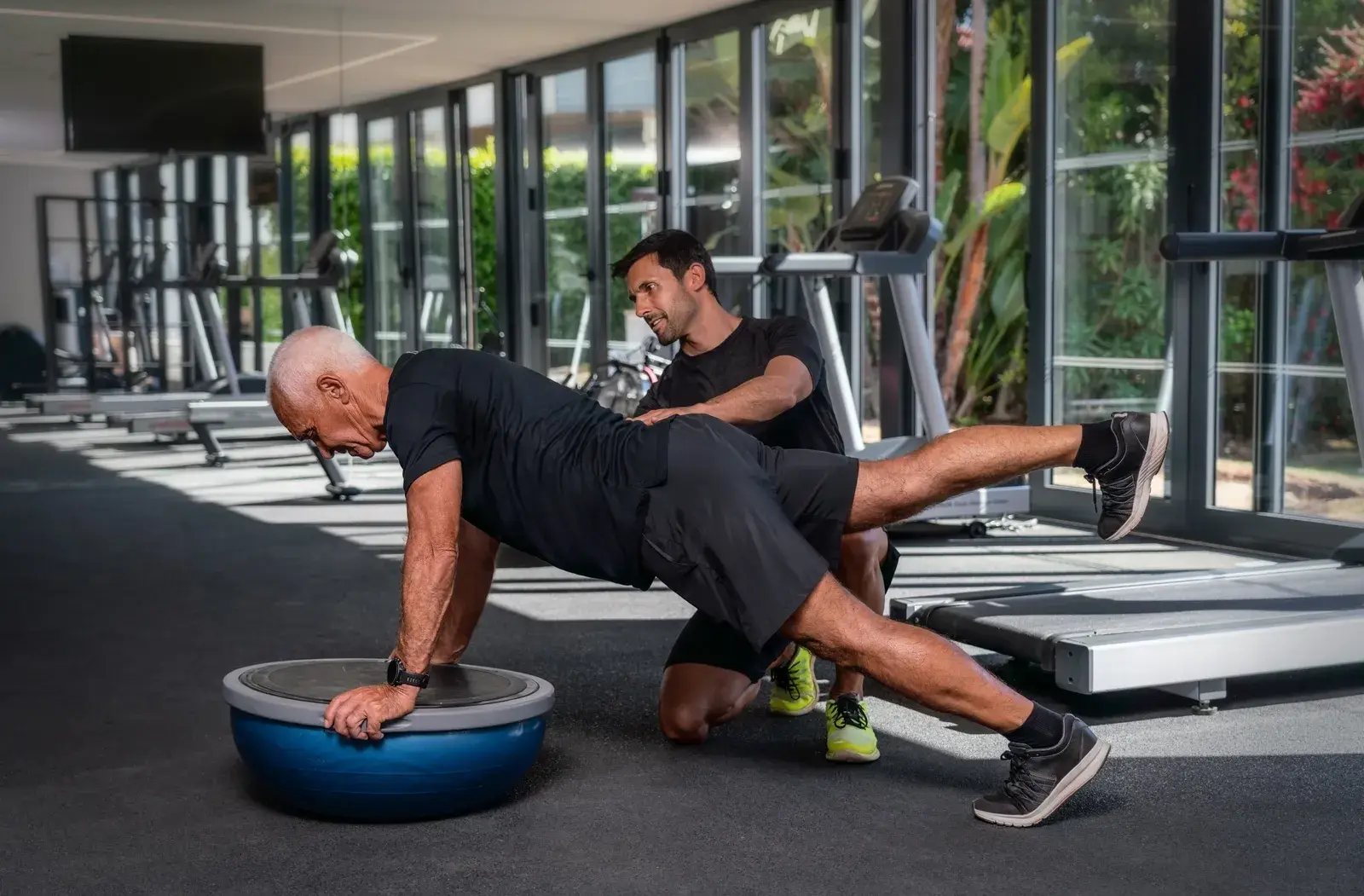
The exercises that make sense are compound strength movements done with good form and gradually heavier load, balance training that challenges you safely, and back extensor work that supports an upright posture. Squats to a box, deadlift patterns built on a hip hinge, step-ups, rows, presses and loaded carries are common building blocks.
Learning the hip hinge, bending at the hips with a long spine, is often an early goal because it carries over to lifting groceries, grandchildren and garden bags. Balance work progresses from standing with feet close together to single-leg stands, stepping drills and walking with head turns. Impact, such as heel drops or small hops, may be added for people whose bones and joints allow it.
The private suites hold a lifting rack, cable system, dumbbells and a bench, which means a therapist can coach these lifts at real loads while watching every repetition. Movements that combine heavy forward bending with twisting, such as loaded sit-ups or toe touches with weight, are usually left out or modified.
Loads start lighter than many people expect and climb in small steps as technique holds. Some people with low bone density worry that any weight could break a bone; a supervised start, with the therapist choosing loads from what you show you can control, is a reasonable way to rebuild confidence before training on your own.
- Box squats, step-ups and hip-hinge deadlift patterns
- Rows, presses and carries for upper body and grip
- Back extensor strengthening for posture
- Balance drills that progress safely
- Impact work only when bones and joints allow
How long before strength training makes a difference to bone and balance?
Strength and balance usually improve noticeably within 8 to 12 weeks of consistent training, while changes in bone density take much longer and are measured on DXA scans that are usually repeated no more often than every year or two; Medicare, for example, covers a repeat scan once every 24 months unless more frequent testing is medically necessary. Feeling steadier on stairs and lifting with more confidence often comes first.
Bone adapts slowly, which is why training needs to continue long after a course of physical therapy ends. A common pattern is a block of supervised sessions to learn the lifts and set safe starting loads, followed by a gradual handover to independent training at least twice a week, with occasional check-ins.
After discharge, some people continue with coaches at FlexWerk next door, as described on the post-rehab strength training page. Your therapist cannot promise a change in your bone density, and medication decisions remain with your physician.
Nutrition and lifestyle sit alongside the exercise. Adequate calcium, vitamin D and protein, not smoking and limiting alcohol are all part of standard bone health advice, and your physician or a dietitian can tell you what applies to you. The therapist’s part is the training and the movement habits.
How do I lower my fracture risk at home and on icy Carmel sidewalks?
Lowering fracture risk at home starts with reducing falls: clear floor clutter, light the path to the bathroom at night, put non-slip mats in the shower and keep frequently used items within easy reach. According to the CDC, the large majority of hip fractures that send older adults to the emergency department or hospital are caused by falls.
Winter adds its own risk in central Indiana. Wear boots with deep tread, consider ice cleats for walks, take shorter, flatter steps on slick patches and use the indoor track or a treadmill on the worst days. The winter fall prevention on ice guide covers more. Daily habits matter too: bending at the hips instead of rounding the back to unload the dishwasher or lift a laundry basket spreads load more safely.
If you have been told you have osteoporosis or low bone density and are unsure how to exercise, fill in the physical therapy questionnaire. The matching team reads it and gets back to you about a therapist in the network whose focus includes bone health and balance. The balance and fall prevention page explains that side of care.
When to see a physician or go to the ER first
Physical therapy is the right start for most osteoporosis. These symptoms are different and need medical attention before, or instead of, a physical therapy visit:
- Sudden, severe back pain after a minor strain, cough or no clear cause
- A fall followed by hip or groin pain or inability to bear weight
- Wrist pain and deformity after landing on an outstretched hand
- Rapid height loss or a quickly worsening forward curve of the upper back
- New numbness or weakness in the legs with back pain
If you think it is an emergency, call 911.
Two-minute assessment
Get your osteoporosis looked at
Tell us how your osteoporosis started, how long it has been going on and what it is stopping you from doing. The matching team proposes a therapist in the network who focuses on it, and you hear back, usually within one business day.
- No referral needed to start in Indiana (first 42 days)
- We check which therapists work with your plan before you book
- One-on-one care in a private suite at Carmel City Center
How therapists treat it
Kinds of care used for osteoporosis
- Balance and fall preventionStrength, walking and balance training for older adults who feel unsteady, have fallen, or want to stay confident on their feet.
- Post-rehab strength trainingThe bridge from discharge to lasting strength: a written handoff from your therapist to a FlexWerk coach in the same building.
- Orthopedic physical therapyExercise-led care for back, neck, shoulder, hip, knee and ankle problems, delivered one-on-one in a private suite.
Questions
Osteoporosis: what people ask
Information on this website is general education, not medical advice, a diagnosis or a treatment plan. Only a licensed clinician who examines you can advise on your condition. If you may be having a medical emergency, call 911.
Something we did not cover? Ask the matching team or ring (888) 353-9975.
Is lifting weights safe with osteoporosis?
For many people it is, when the program is chosen for their bones and fracture history and progressed gradually with good technique. Supervision early on is wise, especially after a spinal fracture.
Should I avoid bending forward with osteoporosis?
Loaded forward bending and twisting of the spine, such as weighted sit-ups, is usually avoided. Bending at the hips with a long spine is a safer way to reach the floor.
Is walking enough to protect my bones?
Walking is good for health and balance, but on its own it is a modest stimulus for bone. Guidance generally adds resistance training and balance work for people with osteoporosis.
Can I do yoga or Pilates with osteoporosis?
Many poses are fine, but deep forward folds, full twists and rolling exercises may need changing. Tell the instructor about your diagnosis, and a therapist can help you sort which moves suit you.
Does Medicare cover physical therapy for osteoporosis?
Medicare Part B can cover outpatient physical therapy when it is medically necessary and the plan of care is certified. The Medicare physical therapy coverage page explains how that works.
Google reviews
What guests say about FlexWerk
These are live Google reviews of FlexWerk at Carmel City Center, the private-suite facility where therapists in the network practise.
Related
Conditions that travel together
 Spinal compression fractureSafe movement, spinal extensor strength and fall prevention after an osteoporotic or traumatic vertebral fracture.
 KyphosisBack extensor strength, mobility and balance training for a rounded upper back in teens and adults.
 DeconditioningRebuilding strength, walking stamina and balance after a hospital stay, illness or long period of inactivity.
Page reviewed By the Monon Therapy Collective editorial team

Carmel City Center · Carmel, Indiana
Start with a conversation
Tell us what hurts and what you want to get back to. We will tell you honestly whether a therapist in the network is likely a good fit for what you describe, and match you with an independent, licensed therapist who is. Only that therapist can assess what will help.
885 Monon Green Blvd, Suite 120, Carmel, IN 46032 · Monday to Friday 5 AM to 9 PM · Saturday and Sunday 7 AM to 4 PM