Rehab after Achilles tendon repair usually runs six to nine months, and the work is about rebuilding calf power without letting the healing tendon stretch out. Most people move from a splint to a boot with heel wedges, start supervised physical therapy within the first several weeks, leave the boot somewhere around two to three months, and return to running and court sport later. In Carmel, the matching team can connect you with an independent, Indiana-licensed physical therapist who treats one-on-one in a private suite at Carmel City Center.
Last reviewed By the Monon Therapy Collective editorial team
- Full activity
- About 6 months for many people (MedlinePlus)
- Full recovery
- About 9 months, often longer for jumping sports
- Key test
- Repeated single-leg heel raises, side to side
- Main early risk
- Overstretching the repair before it is strong
Why is an Achilles repair rehabbed so differently from other tendon surgeries?
It is rehabbed differently because the goal is to heal the tendon at the right length, not simply to regain flexibility. A repaired Achilles that heals even slightly long leaves the calf unable to lift your heel fully, so early rehab deliberately protects the tendon from stretching while it knits. That is why your foot is first held pointed down and then brought up toward neutral in small, planned steps.
The Achilles is the tendon that joins the calf muscles to the heel bone, and you use it every time you push off to walk, climb stairs or jump. Ruptures often happen during an explosive push-off: a lunge for a ball on a pickleball court, a sprint start, a jump in pickup basketball. MedlinePlus notes that many people return to full activity in about six months and that full recovery takes about nine months, with roughly 5 in 100 people tearing the tendon again.
Because of that re-tear risk, the long middle phase of rehab matters as much as the first weeks. People tend to feel normal walking well before the tendon can tolerate running or a hard change of direction, and that gap is where patience pays off.
What do the phases of Achilles rehab look like by week?
The phases move from protection, to restoring walking, to strength, to speed and sport. The timings below are typical ranges drawn from published surgical protocols and patient guidance; your surgeon’s protocol sets the actual dates, and some surgeons now start weight bearing and motion earlier than older protocols did.
| Weeks after surgery | Main goals | Typical milestones |
|---|---|---|
| 0 to 2 | Protect the repair, settle swelling, keep the wound healthy | Splint or cast with toes pointed; leg elevated much of the day; crutches or a knee scooter |
| 2 to 6 | Begin loading in a boot, gentle ankle motion within limits | Boot with heel wedges removed in stages; partial to full weight bearing as cleared; supervised therapy often begins |
| 6 to 12 | Walk normally without the boot, start calf strengthening | Weaning from the boot into a shoe with a small heel lift; seated then standing two-leg heel raises; stationary bike |
| 12 to 24 | Build single-leg calf strength and endurance | Single-leg heel raises with added load; balance work; light jogging only after strength criteria and surgeon clearance |
| 24 to 40 and beyond | Restore power and sport skills | Hopping and landing drills, change of direction, graded return to court or field sport |
Which Achilles rehab decisions belong to your surgeon, not your therapist?
Your surgeon decides when you may put weight through the leg, how quickly the heel wedges come out, when the boot comes off and when you are cleared for running. The physical therapist you are matched with works inside those limits, measures how you are doing against them, and tells the surgeon’s office if something looks off.
Repair technique changes the plan. A minimally invasive repair, an open repair, and a repair of a tendon that had been degenerating for years before it failed can each carry different timelines. Bring the written protocol to your first visit; if you do not have one, the therapist’s office can request it. Wound checks, blood clot screening and any decision about imaging also stay with the surgical team.
What a therapist adds is measurement and dosing: how much calf work today, how to read next-morning stiffness, when a single-leg heel raise is good enough to try jogging. Our page on post-surgical rehabilitation explains how that shared care usually works.
How do you know the calf is strong enough to start jogging after an Achilles repair?
You know through testing, not the calendar. Many rehab protocols look for a single-leg heel raise that lifts as high as the other side and repeats for a meaningful number of reps before jogging begins, along with a normal walking pattern, no limp after a long walk, and little or no swelling the next morning.
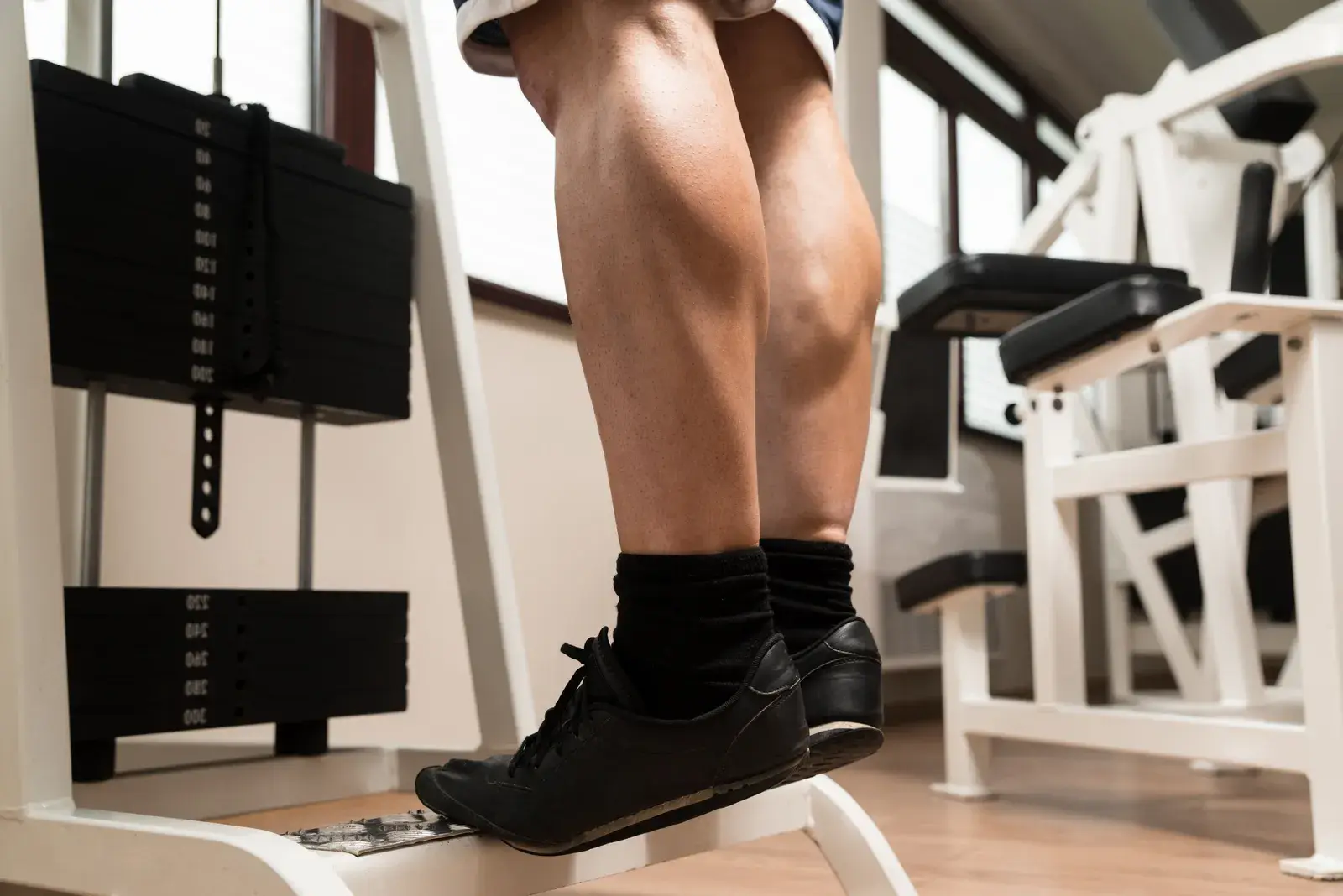
A typical session in a private suite at FlexWerk might pair heel raises on a step with a loaded barbell or dumbbells, seated calf raises on the bench with weight on the knee, and balance work on the indoor turf. Your therapist may count reps to fatigue on each leg and record heel height, because a repaired Achilles often lifts lower even when it lifts as many times.
Running usually comes back as intervals, short jogs mixed with walking, on flat ground. The Monon Trail is level and paved, which makes it a common first route, and the surface near Carmel City Center is predictable underfoot. Our walk-run plan for returning after injury shows how those blocks are usually built.
- Single-leg heel raise height close to the uninjured side
- Repeated single-leg heel raises without the knee bending to cheat
- Brisk walking for 30 minutes without a limp
- Hopping on two feet without pain or apprehension
- Surgeon clearance for impact
Is prehab worth doing in the days before Achilles surgery?
A short burst of prehab can help, but Achilles surgery is often done within days to a couple of weeks of the rupture, so there is little time. What is worth doing is practicing crutch or knee scooter use, setting up your home for several weeks without using the injured foot, and keeping the other leg, hips and upper body active.
If you are deciding between surgery and non-surgical treatment in a functional brace, that conversation belongs to your surgeon. MedlinePlus notes both routes can produce similar outcomes for some people. Either way, the rehab principles overlap, and our page on an Achilles rupture covers the non-surgical path.
When the surgeon clears you for outpatient therapy, the questionnaire asks for your surgery date and current boot stage. That lets the matching team propose a therapist who can see you at a time that works with crutches and a ride, including weekend suite hours from 7 AM.
Call your surgeon or seek care urgently after Achilles surgery if you notice
- Calf pain, warmth or swelling that gets worse rather than better, or sudden shortness of breath or chest pain (possible blood clot: call 911 for breathing symptoms)
- A new pop, a sudden loss of push-off, or a gap you can feel at the back of the ankle
- Wound redness, drainage, opening or a fever
- Numbness along the outer foot that is spreading
If you think it is an emergency, call 911.
