Physical therapy for seniors in Carmel focuses on the things that keep you independent: leg strength for getting out of a chair, balance for curbs and ice, and walking far enough to enjoy the day. The matching team reads your questionnaire and proposes an independent, Indiana-licensed physical therapist who works one-on-one in a private suite at Carmel City Center. If you use Medicare, a physician or qualified provider certifies the plan of care your therapist writes.
Last reviewed By the Monon Therapy Collective editorial team
- Main goals
- Fewer falls, easier stairs, longer walks
- Common test
- 30-second chair stand
- Medicare
- Plan of care needs provider certification
- Getting there
- Garage parking a short walk from the suites
What do older adults usually see a physical therapist for?
Most older adults come for one of four reasons: a fall or a near miss, a painful joint that is shrinking their day, recovery after a hospital stay or operation, or a general loss of strength that makes stairs and car transfers harder. Often two or three of these overlap, and a good plan addresses them together rather than one at a time.
Falls deserve the first mention. The CDC reports that more than one in four older people falls each year, and fewer than half tell their doctor. A fall that caused no injury is still worth reporting to a therapist, because the reason behind it (weak hips, slow reactions, a medication change, poor footwear) is often something you can work on.
| Problem | What it tends to look like | Read more |
|---|---|---|
| Fall risk and poor balance | Holding furniture at home, slower walking, fear of curbs | Balance and fall prevention |
| Knee osteoarthritis | Stiff first steps, pain on stairs, swelling after a long day | Knee osteoarthritis |
| Spinal stenosis | Legs tire when standing or walking, relief when leaning on a cart | Spinal stenosis |
| Osteoporosis | Worry about safe lifting and bending after a bone density scan | Osteoporosis |
| Loss of strength after illness | Weeks in bed or a hospital stay, now winded and weak | Deconditioning |
How does a therapist measure fall risk in someone over 65?
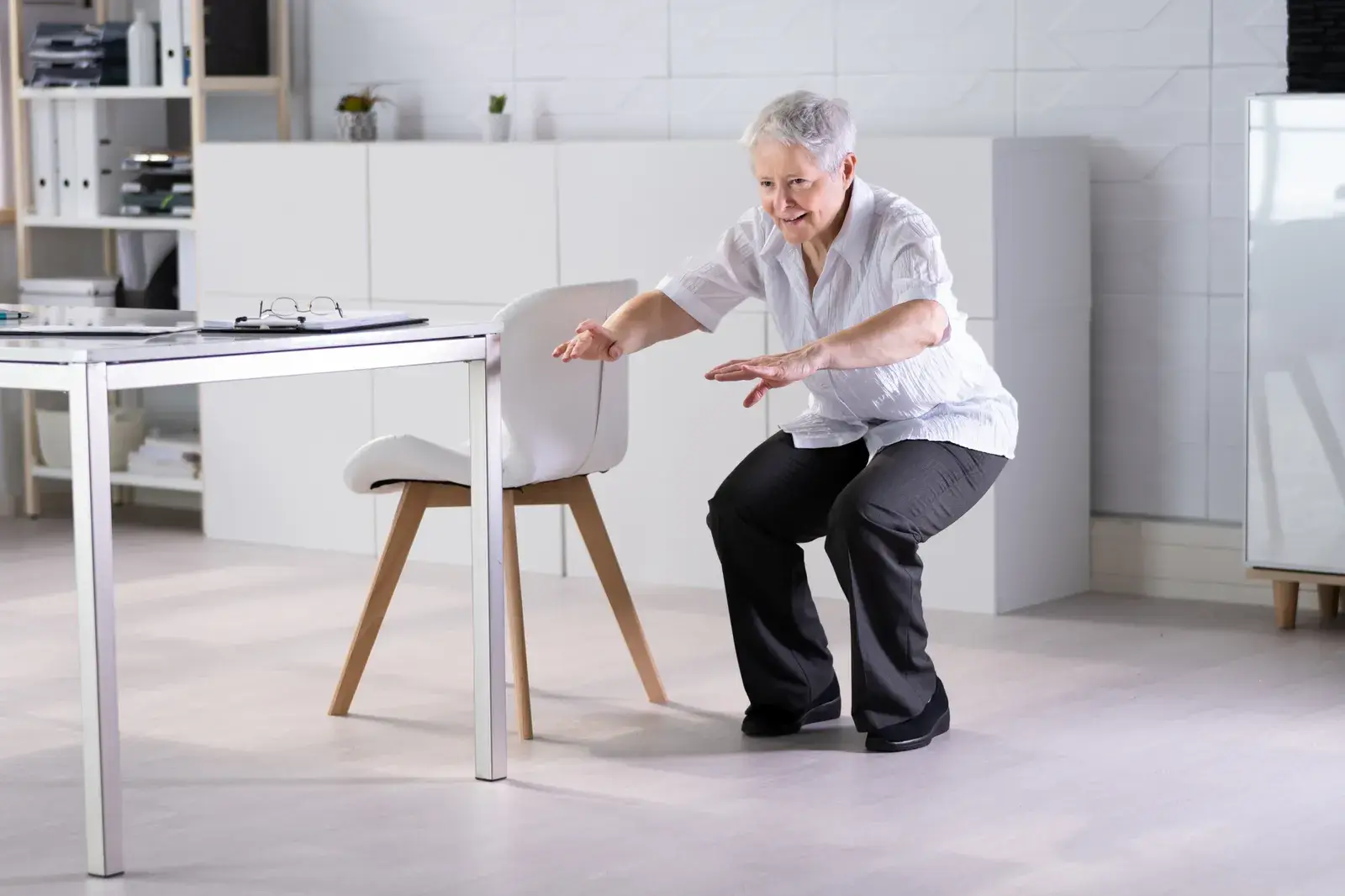
A therapist measures fall risk with short, repeatable tests rather than a guess. One widely used example from the CDC’s STEADI toolkit is the 30-second chair stand: arms crossed at the wrists, you stand up fully and sit down as many times as you can in 30 seconds from a straight-backed chair about 17 inches high, and the count is compared with age norms.
Your therapist may add a timed walk, a test of standing on one leg, a look at how you turn and step over objects, and questions about dizziness, vision, footwear and medications. Each number becomes a baseline. Retesting every few weeks shows whether the plan is working, which matters more than how you feel on any single day.
If dizziness when you roll over in bed or look up is part of the picture, ask the matching team about vestibular therapy; whether a therapist in the network offers it depends on who is in the network at the time, and the team says so plainly before anything is booked.
Is strength training safe for people in their seventies and eighties?
Yes, when it is dosed for you, strength training is one of the most useful things an older adult can do. The CDC physical activity guidelines for older adults include muscle-strengthening activity at least two days a week, plus balance work. Age alone is not a reason to avoid it; heart conditions, osteoporosis and recent surgery change how it is done, not whether.
In a private suite that usually means a sit-to-stand from a raised seat, step-ups to a low box, cable rows and carries with light dumbbells, progressed by small amounts. The suites have a rack, bench and cable system, but nothing about the session is gym-floor intense: the door is closed, the music is your choice, and the therapist is beside you for every set.
How does Medicare handle outpatient physical therapy for seniors?
For older adults on Original Medicare, Part B is the part that pays toward outpatient physical therapy when it is medically necessary. After the Part B deductible, you generally pay 20% of the Medicare-approved amount, and a physician or other qualified provider must certify the plan of care your therapist writes. Indiana’s direct access law lets you start without a referral, but that certification is still needed for Medicare to pay.
There is no hard yearly cap on medically necessary therapy, but above a set spending level the therapist’s office has to confirm on the claim that care is still medically necessary. The details are on Medicare and physical therapy coverage and in whether Medicare limits physical therapy visits. The matching team asks about your Medicare or Medicare Advantage plan and proposes a therapist whose office works with it where possible; that office verifies benefits before your first visit.
Outpatient suite or home visits: which suits an older adult better?
An outpatient suite suits you if you can get in and out of a car and walk a short distance with or without a cane. Home health therapy is designed for people who are homebound, which Medicare defines strictly, and the network matches people to care in the suites rather than to home visits. Compare the two in home health versus outpatient physical therapy.
For the trip itself, the Carmel City Center garage is a short walk from the suites, and you can bring a family member or friend into the session. Midday appointments avoid rush-hour traffic on Keystone Parkway and US-31. In winter, plan the walk from the garage with the same care you would give any icy lot, and read preventing falls on winter ice before the first freeze.
Get medical help first if
These need a physician, urgent care or 911 before physical therapy.
- A fall with a blow to the head, especially if you take a blood thinner
- Sudden weakness, facial drooping, slurred speech or confusion
- New hip or groin pain after a fall that makes standing or walking hard
- Fainting, chest pain or breathlessness with light activity
- A sudden change in balance with a new headache or double vision
If you think it is an emergency, call 911.
