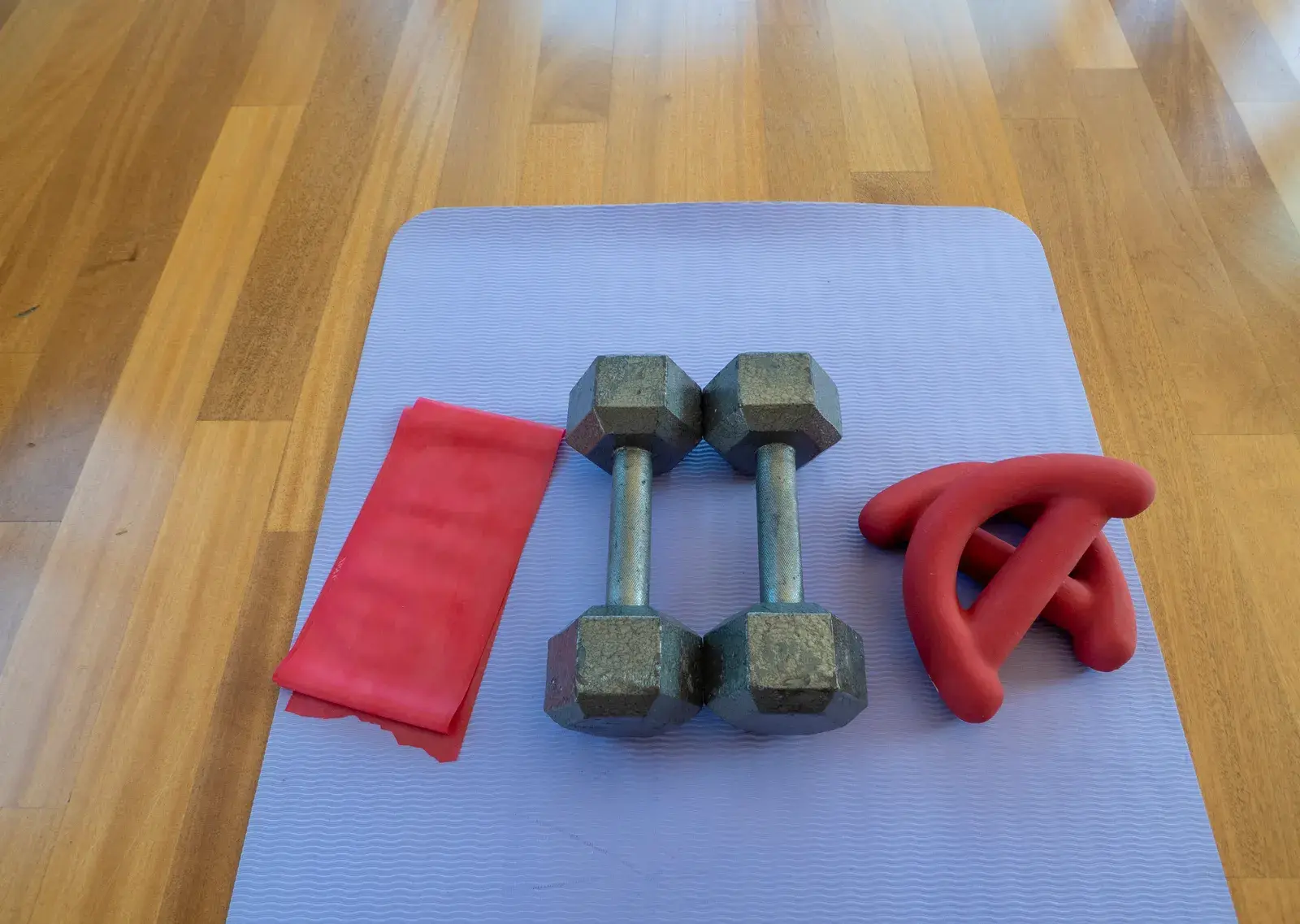
Most home rehab programs need very little: a sturdy chair, a wall, a step and a towel cover a surprising amount, and a set of resistance bands plus one or two light dumbbells or a kettlebell covers most of the rest. Buy equipment for the exercises your physical therapist has actually given you, not for a program you might do one day. Expensive gadgets such as inversion tables, vibration plates and massage guns are optional extras at most, and none of them replaces progressive strengthening.
Last reviewed By the Monon Therapy Collective editorial team
- Start with
- A chair, a wall, a step and a towel
- First purchase
- A set of resistance bands
- Next
- Light dumbbells or a kettlebell
- Usually skip
- Gadgets that promise to do the work for you
What household items can I use instead of rehab equipment?
A firm chair, a wall, the bottom stair, a bath towel and a backpack you can load with books handle many home programs. These items cover sit-to-stands, wall slides, step-ups and step-downs, towel stretches and loaded carries, which are staples of rehab for the back, hip, knee and shoulder.
The point is to start the program today rather than wait for a delivery. A chair with armrests lets you adjust how much your hands help on a sit-to-stand. The bottom stair, with a hand on the rail, is a ready-made platform for the step-down exercise. A wall gives the shoulder a guide for the shoulder wall slide. A backpack loaded with a few books, worn on the front or carried by one strap, becomes adjustable resistance for hinges, carries and squats.
- Firm chair, ideally with armrests
- A wall with clear floor in front of it
- The bottom stair with a handrail
- A bath towel or a belt for stretches
- A backpack or grocery bags you can load gradually
- Cans or water bottles for very light arm work
Which pieces of rehab equipment are worth buying first?
A set of resistance bands is the most useful first purchase for almost any home program, followed by light adjustable weights once you outgrow the bands. The table summarizes what each common item is for and when it earns its space.
| Item | What it is used for | Worth it if | Probably skip if |
|---|---|---|---|
| Loop bands (small) | Hip work like monster walks and clamshells | You have hip, knee or back exercises | Your program is only for the upper body |
| Long tube or flat bands with a door anchor | Rows, presses and banded external rotation | You are rehabbing a shoulder, elbow or upper back | You already have a cable machine to use |
| Light dumbbells or an adjustable pair | Rows, presses, carries, calf raises with load | Bands have become too easy | You are in the first gentle weeks after surgery |
| One kettlebell | Deadlifts, goblet squats, carries | You are working on lifting and hip strength | You cannot yet hinge without pain |
| Foam roller | Comfort before or after exercise, thoracic mobility | You like how it feels | You expect it to fix the problem on its own |
| Balance pad | Progressing single-leg balance | You are past basic balance on the floor | You still need to hold a counter to balance |
| Small step or aerobic step | Step-ups, step-downs, calf raises | You have no safe stair to use | You have a stair with a rail |
How do I choose resistance bands for physical therapy?
Buy a set with several resistance levels rather than a single band, because you will move up as you get stronger and different exercises need different tension. Bands are usually color coded by resistance, but colors and strengths vary by brand, so read the labels rather than assuming yellow is light.
Long bands with handles and a door anchor suit shoulder and upper-back work; small loop bands suit hip work around the thighs; long flat bands can be tied into loops. Check bands for nicks or thinning before every session and replace them when they show wear, since a snapping band can hit the face. If you have a latex allergy, choose latex-free bands. Close the door anchor on the hinge side of the door, not the side that opens toward you.
Are foam rollers, massage guns and inversion tables worth buying?
They are optional. A foam roller or massage ball can make stiff muscles feel looser for a while and some people enjoy using one before exercise, but the effect is short-lived, and none of these tools builds the strength or tolerance that most rehab is aiming for. Buy one if you like it, not because you think you have to.
Inversion tables are not suitable for everyone, their benefit for back pain is uncertain, and you should ask your doctor before hanging upside down if you have any heart, blood pressure or eye condition; read whether inversion tables help back pain before buying. The same thinking applies to foam rolling, vibration plates and posture correctors: comfort tools at most. TENS units and braces are worth discussing with your therapist first, because the right use depends on your condition.
What equipment helps in the first weeks after surgery?
In the first weeks after an operation, safety and comfort items usually matter more than exercise gear: a firm chair with armrests, a cold therapy pack, a strap or towel for gentle range of motion exercises, and anything your surgeon’s discharge instructions list, such as a raised toilet seat or a shower chair after a hip replacement.
Hold off on buying weights until your therapist has set the first strengthening exercises; early programs after knee, hip and shoulder surgery mostly use body weight and very light bands. The guide to preparing your home for a hip replacement lists the practical items for that surgery in detail.
How much space do I need for a home rehab setup?
Enough floor to lie down with your arms out, a clear wall, and a spot where you can step sideways a few paces covers almost every home program. A yoga mat or a rug marks out the space and protects your knees and back on hard floors.
Keep everything in one bin or basket near where you will exercise. Equipment buried in a closet tends not to be used, and the hardest part of a home program is usually doing it, not owning the kit. The guide to sticking with your home exercise program has practical habits that help, and the answer on doing physical therapy exercises at home explains why the home part matters so much.
Should I ask my physical therapist before buying equipment?
Yes, ideally at your first or second visit, once your therapist has set your initial exercises. They can tell you which items your program actually needs, what resistance level to start with, and which purchases can wait until later in rehab.
Therapists in the network work in private suites that have a rack, cable system, dumbbells and a bench, so you can try exercises with professional equipment during sessions and then decide what is worth recreating at home. That avoids the common pattern of buying a full set of gear, finding half of it is never used, and still missing the one item your program needed. If you have not started yet, the physical therapy questionnaire is the first step: the matching team reads it and proposes an independent, Indiana-licensed therapist in the network.
Stop using a piece of equipment and check with your therapist if
- An exercise causes sharp pain rather than effort or mild discomfort
- Pain or swelling is worse the next morning after using it
- A band shows nicks, tears or thinning
- You feel dizzy or lightheaded, especially on an inversion device
- You cannot control the weight through the whole movement
If you think it is an emergency, call 911.
