Banded external rotation is a shoulder exercise done standing side-on to an anchored band: with the elbow bent to 90 degrees and tucked against your side, you rotate the forearm outward like a gate swinging open, then return slowly. It strengthens the rotator cuff muscles at the back of the shoulder, so physical therapists use it for rotator cuff injuries and shoulder instability. This is general education; after surgery your surgeon’s protocol sets when resisted rotation can start, and a therapist sets the dose.
Last updated By the Monon Therapy Collective editorial team
- Main muscles
- Infraspinatus and teres minor (rotator cuff)
- Position
- Standing side-on, elbow bent to 90 at your side
- Equipment
- A resistance band, an anchor at elbow height, a small towel
- Often used for
- Rotator cuff injury, shoulder instability
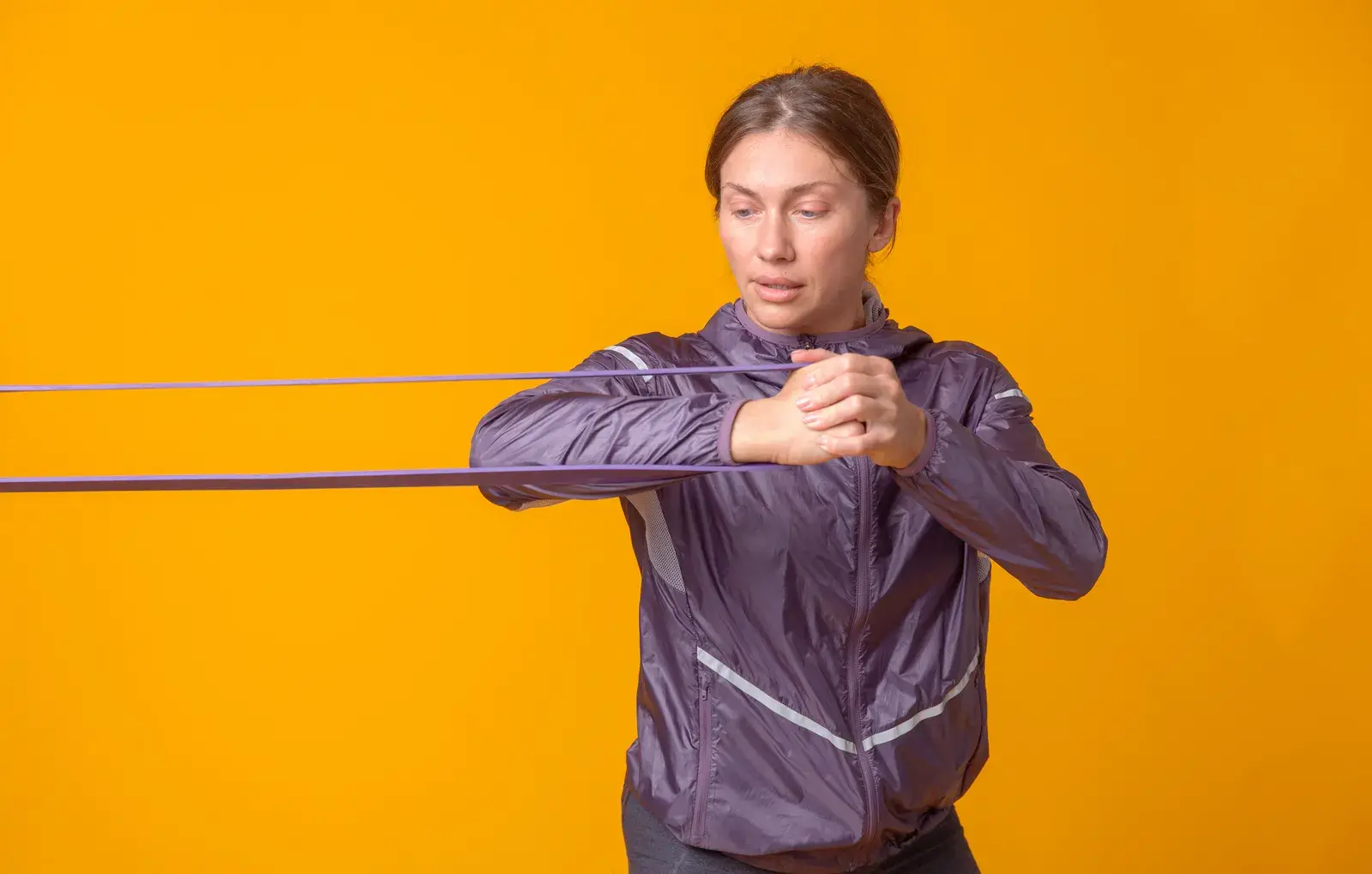
What does external rotation strengthen in the rotator cuff?
It strengthens the infraspinatus and teres minor, two of the four rotator cuff muscles, which sit on the back of the shoulder blade and turn the arm outward. Together with the other cuff muscles they keep the ball of the shoulder centered in the socket as the arm moves.
Those muscles are often weak or sore with a rotator cuff injury, and they matter for daily tasks such as reaching behind you, brushing your hair and putting on a jacket. Strengthening them is one of the most common parts of shoulder rehab.
Why put a towel under the elbow for external rotation?
The towel keeps the elbow from drifting away from your side, which would let the bigger shoulder muscles take over. If the towel falls, the arm moved.
It also holds the arm slightly away from the body, a position many people find more comfortable for the shoulder. Without it, people often press the elbow hard into the ribs or let it wander, and either one changes which muscles work.
When does external rotation fit after a rotator cuff repair or a dislocation?
After a rotator cuff repair, resisted external rotation usually waits weeks, because the repaired tendon needs time to heal to bone. Early on, therapists typically move the arm for you or use gentle assisted motion, following the surgeon’s protocol.
With shoulder instability, rotating the arm outward while it is raised out to the side can feel unstable, so the elbow-at-the-side version is the usual starting point. Higher positions come later, once the shoulder is stronger and more confident. The shoulder matching questionnaire takes about two minutes.
External rotation mistakes that shift the work
The most common mistake is twisting the trunk to swing the band, which makes the arm move without the cuff doing much.
- Turning the body to help the forearm rotate.
- Letting the elbow leave the side or the towel drop.
- Bending the wrist back instead of rotating the forearm.
- Using a band so strong that the movement jerks.
- Letting the band snap the arm back instead of returning slowly.
External rotation progressions for throwers and swimmers
Progression usually moves from no-movement holds to standing band work and then to arm positions used in sport. Throwers and swimmers often end up in the 90/90 position, arm out at shoulder height and elbow bent.
- Easiest: press the back of the wrist into a doorframe without moving.
- Side-lying rotation with a light dumbbell.
- Standing band rotation with the elbow at the side.
- Band rotation with the arm partway out to the side.
- 90/90 rotation for throwing and swimming.
- Cable column rotation, like the cable systems in the suites at Carmel City Center.
Banded external rotation, step by step
Choose a light band; the rotator cuff muscles are small, and control matters more than resistance here.
Anchor the band
Attach a band at elbow height. Stand side-on with the working arm farthest from the anchor and hold the band in that hand.
Place the towel
Fold a small towel and tuck it between your elbow and side. Bend the elbow to 90 degrees with the forearm across your stomach.
Set the shoulder
Draw the shoulder blade gently back and down without pinching it, and stand tall.
Rotate out
Keeping the elbow on the towel and the wrist straight, rotate the forearm outward as far as you can control, like a gate opening. Breathe out as you rotate.
Return slowly
Let the forearm return to your stomach over two to three seconds. Your therapist decides band strength, sets and repetitions.
Stop and get your shoulder assessed if...
- You feel a sudden pop with new weakness lifting the arm.
- The shoulder feels like it is slipping out.
- Pain at night keeps you awake and is getting worse.
- Numbness or tingling runs down the arm.
- After surgery, pain rises sharply or the incision looks red.
If you think it is an emergency, call 911.
