The monster walk is a banded walking drill: with a loop band around your legs and your hips and knees slightly bent, you take wide, diagonal steps forward or backward, keeping tension on the band the whole time. It works the muscles on the side of the hip, especially the gluteus medius, which help keep the pelvis level and the knee from collapsing inward when you run, climb stairs or land. Therapists use it in rehab for runner’s knee, IT band syndrome and some outer hip pain, but this page is general education only; a therapist decides whether it suits your hip and how much resistance to use.
Last updated By the Monon Therapy Collective editorial team
- Main muscles
- Gluteus medius and other hip abductors and rotators
- Equipment
- A loop resistance band
- Band position
- Above the knees, at the ankles or around the forefoot
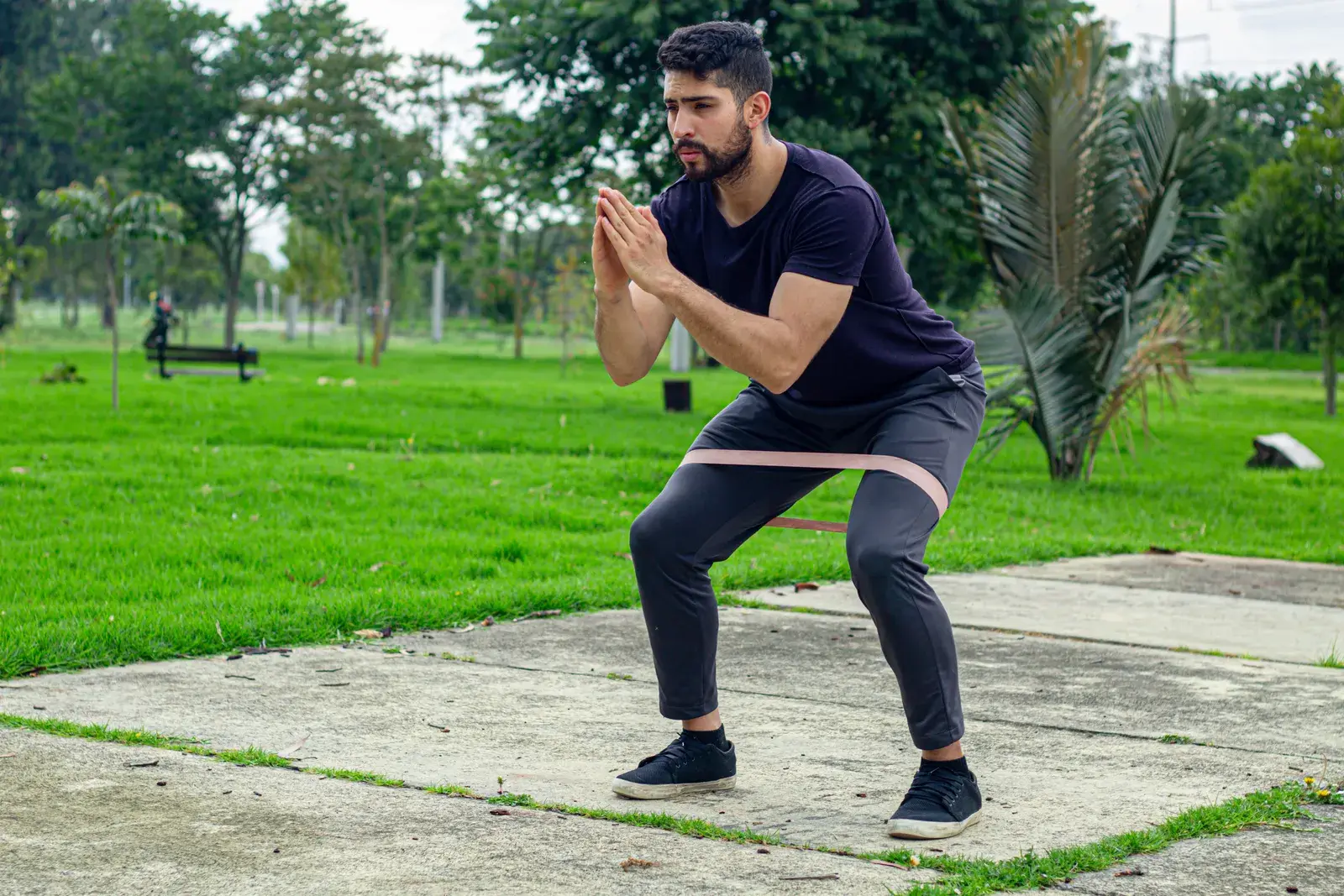
Monster walk or lateral band walk: what is the difference?
A monster walk moves forward or backward on a diagonal, with each step going out and ahead, while a lateral band walk moves straight sideways. Both train the side of the hip, but the diagonal step adds a bit more demand on hip rotation and on controlling the knee as you travel forward.
Therapists often use both, sometimes in the same session, because sport and daily life involve moving in every direction. If you are earlier in rehab and standing drills are too much, the clamshell exercise works similar muscles while lying on your side.
Why does band position change how hard the monster walk feels?
The farther the band sits from your hips, the longer the lever and the harder the muscles have to work. A band just above the knees is the easiest common placement; at the ankles it is harder; around the front of the feet it is harder again.
Band strength matters too, but moving the band is often the simpler way to progress. People with pain on the outside of the hip are a special case: squeezing a band across the side of the hip, or letting the knees drift toward each other, can press on irritated tendons, so a therapist may start them with gentler holds before banded walking. The hip bursitis page covers that kind of pain.
Which knee and hip problems is the monster walk used for?
The monster walk is mostly used when weak hip muscles let the thigh drop inward during running or stairs, which can add strain at the knee and along the outside of the leg. It is a supporting exercise, usually paired with direct strength work for the thigh and calf.
- Runner’s knee, the ache around or behind the kneecap that flares on stairs and hills.
- IT band syndrome, a sharp pain on the outside of the knee that often builds a few miles into a run on the Monon Trail.
- Knee control work after an ACL injury, once the surgeon’s or therapist’s plan allows banded drills.
- General hip strength for people returning to court sports such as pickleball and tennis.
What monster walk mistakes take the work away from the hip?
Standing up too tall and taking small steps is the most common error, because the band goes slack and the hip muscles rest between steps. Stay in a quarter squat and keep the band taut from the first step to the last.
Other habits worth correcting: letting the knees cave toward each other, rocking the trunk from side to side to swing the leg out, dragging the trailing foot, and letting the toes turn out instead of pointing forward. Going slowly, with a deliberate pause on each step, usually makes a light band feel far harder than a heavy band done quickly.
How to do a monster walk, step by step
Place the band
Step into a loop band and slide it to just above your knees, or to the ankles if your therapist has progressed you.
Set the stance
Stand with feet about hip width apart, wide enough that the band has light tension, toes pointing forward.
Sit into a quarter squat
Bend the hips and knees slightly, chest up, weight balanced over the middle of the feet.
Step out and forward
Take a slow diagonal step forward and outward with one foot, keeping the knee lined up over the toes, then do the same with the other foot.
Keep tension and turn back
Walk the distance your therapist set without letting the band go slack, then walk backward on the same diagonal pattern.
Stop the drill and get advice if
- Pain on the outside of the hip gets sharper during the exercise or is worse that night.
- Your knee catches, locks or gives way.
- Groin pain or a deep, pinching pain at the front of the hip appears in the squat position.
- Pain spreads down the leg with tingling or numbness.
If you think it is an emergency, call 911.
