Single-leg balance means standing on one foot, with the pelvis level and the standing knee slightly soft, for a set time, then making it harder step by step. It retrains the ankle’s sense of position and the hip’s control after ankle sprains and in chronic ankle instability, and it is a core part of fall prevention for older adults. This is general education rather than a personal plan; a physical therapist can test your balance safely and set the level and duration that suit you.
Last updated By the Monon Therapy Collective editorial team
- Trains
- Ankle position sense, foot muscles and hip control
- Safety setup
- A kitchen counter or a corner within reach
- Progresses with
- Eyes closed, head turns, soft surfaces, reaching
What does single-leg balance training do after an ankle sprain?
After an ankle sprain, balance training restores the ankle’s ability to sense its position and react quickly, which the injury often disrupts. Ligaments contain sensors that feed the brain information about joint angle, and when they are stretched or torn, reactions on uneven ground can slow down.
That is why balance work is a standard part of ankle sprain rehab, not an optional extra. If the ankle keeps rolling months later, the problem may have become chronic ankle instability, where balance and strength training usually form the center of conservative care. The page on an ankle that keeps giving way describes that pattern.
How should older adults practise balance safely at home?
Practise standing at a kitchen counter or in the corner of a room, with a sturdy surface within easy reach and, at first, someone else at home. Safety comes before difficulty: a balance exercise that causes a fall defeats its purpose.
Keep fingertips on the counter until you can stand steadily without them. Indiana winters add urgency for many people, because icy sidewalks and driveways challenge balance from December to March; the winter fall prevention on ice guide covers footwear and walking technique. A therapist can measure your balance with standard tests and decide whether exercises at home are enough.
Which progressions make single-leg balance harder?
Removing your hands, then your vision, then a stable surface are the classic steps, followed by adding movement such as head turns and reaching. Change only one thing at a time.
| Level | Version | Typical next step when |
|---|---|---|
| 1 | Fingertips resting on a counter | You can hold steadily for the time your therapist set |
| 2 | Hands free, counter still within reach | You stay steady without reaching for support |
| 3 | Turning the head slowly side to side | The head turns do not cause a wobble or dizziness |
| 4 | Eyes closed with the counter right beside you | Only once open-eye balance is solid |
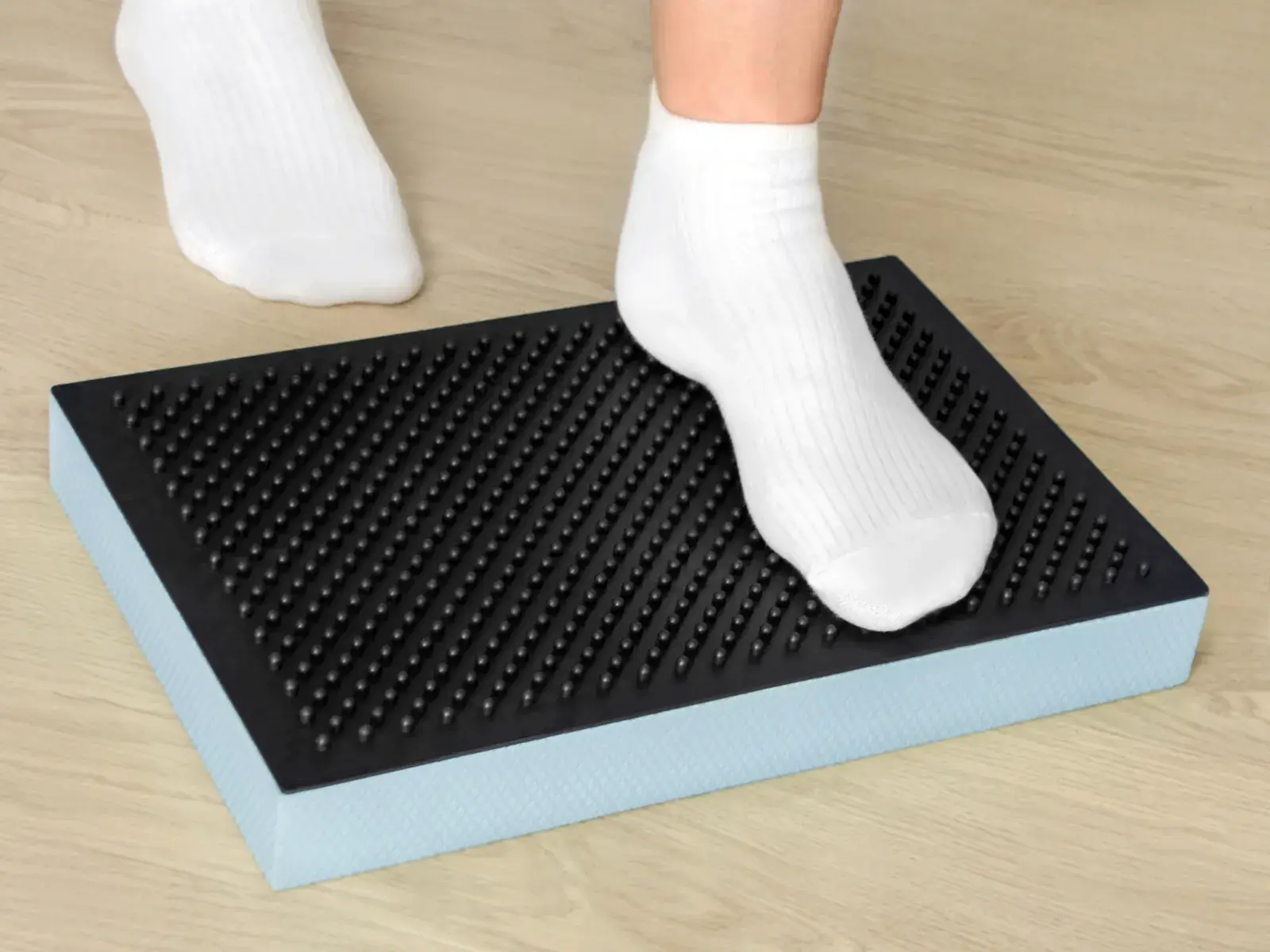
| 5 | Standing on a folded towel or a balance pad | The firm-surface versions are easy |
| 6 | Reaching with the free leg or catching a ball | Sport or work demands require it |
What does good single-leg balance look like in the mirror?
In the mirror, your pelvis stays level, the standing knee lines up over the middle of the foot, and your trunk stays upright with small, quiet corrections at the ankle. Big swaying, a dropping hip or arms windmilling are signs to go back a level.
- Hip dropping on the lifted-leg side, often a sign of weak hip muscles.
- Locking the standing knee straight instead of keeping it soft.
- Clawing the toes into the floor so hard that the foot cramps.
- Staring down at your feet; look at a fixed point at eye level.
- Leaning the whole body over the standing foot.
How to do single-leg balance, step by step
Set up safely
Stand facing a kitchen counter, close enough to rest your fingertips on it, wearing supportive shoes or barefoot on a non-slip floor.
Find your focus
Pick a point on the wall at eye level and keep your gaze there.
Shift your weight
Move your weight onto one foot, spreading it across the heel, the big toe joint and the little toe joint.
Lift the other foot
Lift the other foot just off the floor, keep the pelvis level and the standing knee slightly bent, and breathe normally.
Hold and set down
Hold for the time your therapist recommended, then lower the foot with control and switch sides.
Get checked before balance training if
- You feel the room spinning, or dizziness comes with head movements; the vestibular therapy page explains that kind of problem.
- Your feet are numb or you cannot feel the floor well, which can happen with peripheral neuropathy.
- After an ankle injury you have trouble putting weight on it, or the bone is tender to touch: ask a clinician whether you need an X-ray before you start balance work.
- You have fallen recently and were hurt, or you are afraid of falling at home.
If you think it is an emergency, call 911.
