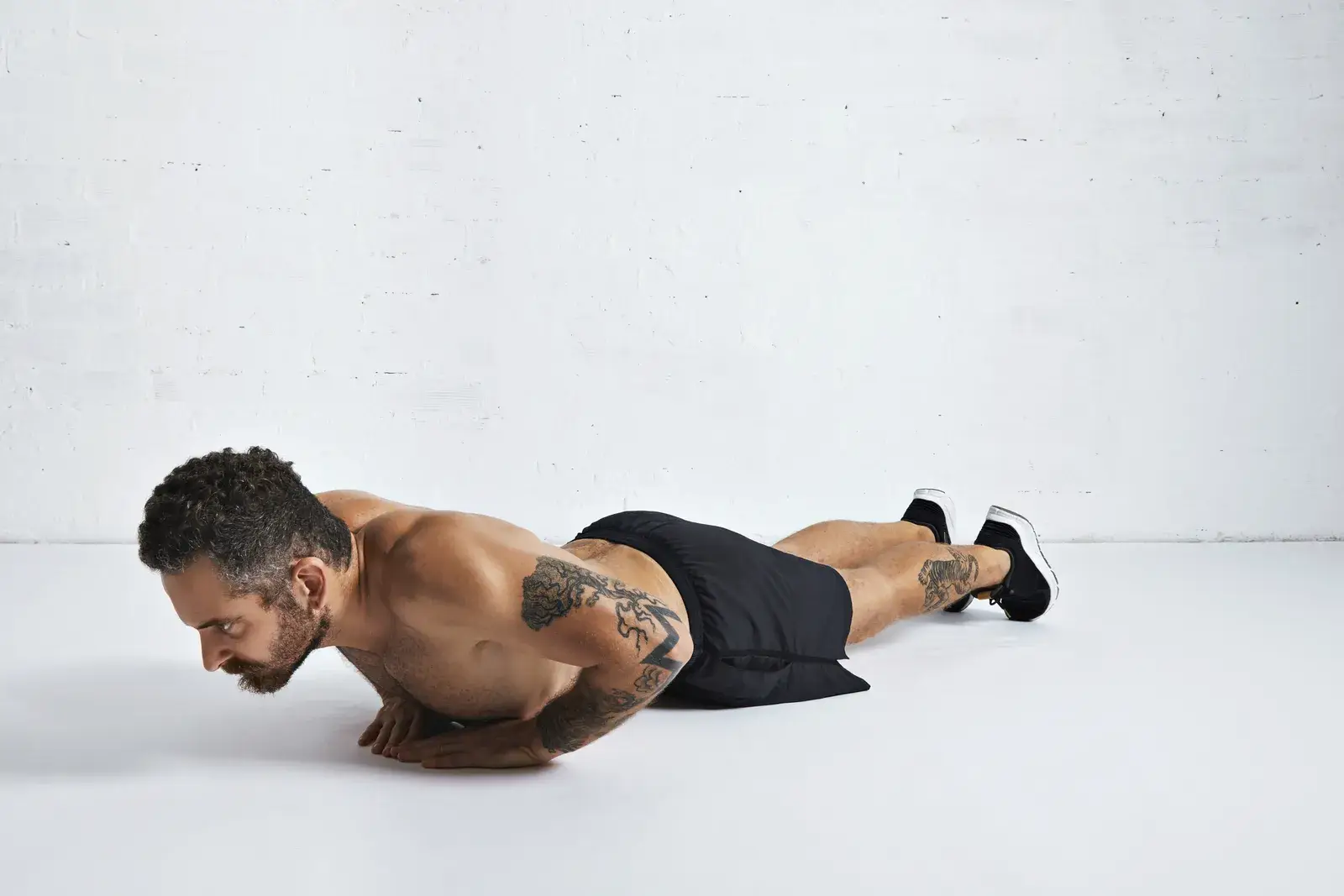
A prone press-up is done lying face down: you place your hands under your shoulders and straighten your arms to lift your chest, while your hips stay on the floor and your low back relaxes into an arch. It comes from the McKenzie approach (also called Mechanical Diagnosis and Therapy) and is used when repeated backward bending reduces back pain or draws leg pain back toward the spine, a pattern common in some disc-related pain. It helps only in that pattern, so this page is general education, not a prescription; a physical therapist tests which direction your back prefers before giving it to you.
Last updated By the Monon Therapy Collective editorial team
- Movement
- Repeated backward bending of the low back
- Muscles
- Arms do the work; the back stays relaxed
- Key sign to watch
- Whether leg symptoms move toward or away from the spine
What is centralization, and why does it decide whether press-ups are right?
Centralization is when pain that spreads into the buttock or leg retreats toward the middle of the back during or after repeated movements, even if the back itself aches a little more. It is generally treated as a favorable sign, and it is the main reason a therapist keeps press-ups in a plan.
The opposite, peripheralization, is when symptoms travel further down the leg. That is a signal to stop the exercise and tell your therapist. If you have pain and tingling down the leg, noting where the symptoms sit before and after a set gives your therapist exactly the information they need. This is also why the exercise is not a general back stretch to hand out to everyone.
How does the press-up progress from lying on your elbows?
Most people start by simply lying face down, then rest on their elbows, then press up partway, and only later straighten the arms fully. Each step adds a little more extension, and a therapist moves you along only when the previous step is calm.
| Stage | Position | What a therapist is checking |
|---|---|---|
| 1 | Lying face down, arms by your sides, a pillow under the hips if flat lying hurts | Whether simply lying in this position is tolerated |
| 2 | Propped on the elbows (sometimes called the sphinx position) | Whether symptoms settle or spread after a minute or two |
| 3 | Half press-up, elbows bending slightly at the top | How far you can extend before symptoms change |
| 4 | Full press-up with the hips staying on the floor | Whether repeated extension keeps centralizing symptoms |
| 5 | Breathing out at the top to let the back sag further | Whether a little more range brings more relief |
| 6 | Standing back bend with hands on the hips | A version for work, travel or after sitting |
Who should not do prone press-ups without being examined first?
Anyone whose back pain gets worse when they stand or lean backward should be examined before trying press-ups, because extension narrows the spaces where some nerves and joints sit. Several common diagnoses fall into that group.
- Lumbar spinal stenosis, where leaning backward often brings on leg symptoms and leaning forward eases them.
- Spondylolisthesis, where one vertebra has slipped forward on the one below.
- Facet joint pain, which is often provoked by arching and twisting.
- Recent back surgery, until your surgeon’s protocol allows extension; see microdiscectomy rehab.
- Later pregnancy, when lying face down is no longer practical or comfortable.
What mistakes make a press-up less useful?
The usual mistake is letting the hips lift off the floor, which moves the bend into the upper back and arms instead of the lumbar spine. Keep the front of the hips heavy on the mat and let the arms do the lifting.
Other common problems are squeezing the buttocks, which stiffens the very segments you want to move; tipping the head back to look at the ceiling; pushing up fast into sharp pain; and judging the exercise on one attempt. Repeated movements are the point, and the response over a full set tells you more than the first repetition does.
How to do a prone press-up, step by step
Lie face down
Lie on your stomach on a firm surface, legs straight and relaxed, hands flat under your shoulders as if setting up for a push-up.
Relax the back
Let your buttocks and low back go loose. Take a breath and notice where any pain sits right now.
Press up slowly
Straighten your arms to lift your chest, keeping the front of your hips on the floor. Go only as far as your symptoms allow.
Let the back sag
At the top, breathe out and let the low back relax downward for a moment.
Lower with control
Bend your elbows to lower back to the floor. Repeat for the number your therapist set.
Check your symptoms
After the set, notice whether leg symptoms have moved toward your spine, stayed the same or spread further, and report it.
Stop the press-ups and call a clinician if
- Pain, numbness or tingling travels further down your leg during or after a set.
- Your foot slaps or catches when you walk, or one leg feels newly weak.
- You notice saddle numbness or new bladder or bowel changes: go to the emergency department.
- The back pain followed a fall, comes with fever, or is constant and unchanged by any position.
If you think it is an emergency, call 911.
