Parkinson’s disease physical therapy in Carmel, Indiana
Physical therapy helps people with Parkinson’s disease keep walking, balance and strength for longer, and the Parkinson’s Foundation recommends a full functional evaluation by a physical therapist before starting an exercise program, plus at least 2.5 hours (150 minutes) of exercise a week. A neurologically trained therapist targets stride length, turning, freezing, getting up from chairs and fall risk, and builds a program you can keep doing between episodes of care. Near Carmel, the matching team confirms before booking whether a therapist in the network currently offers neurologic care.
At a glance
Common signs of parkinson’s disease
Also called: Parkinson disease, PD, Parkinsonism, Idiopathic Parkinson’s disease.
Why does Parkinson’s change the way I walk and turn?
Parkinson’s reduces dopamine signaling in the basal ganglia, the brain area that helps scale and automate movement. The result is movement that becomes smaller and slower without you noticing: steps shorten, arm swing fades, turns break into many little steps, and posture bends forward. Clinicians call the shrinking of movement size hypokinesia and the slowness bradykinesia.
Because the automatic system is less reliable, walking that used to need no thought starts to need attention. Doorways, crowded rooms and turning in a tight kitchen can trigger freezing, a brief feeling that the feet are glued to the floor. Dual-tasking, such as talking while walking, often makes it worse.
Balance reactions also slow, especially stepping backward, which is why falls become a concern as the condition progresses. Rehab cannot stop the disease, but it can make movements bigger and more deliberate, teach workarounds for freezing, and build the strength and balance reserve that lowers fall risk, a theme shared with balance and fall prevention therapy.
What does a neurologic physical therapist measure in Parkinson’s?
The evaluation uses standardized tests so change can be tracked year to year. Common ones include timed walking speed, the Timed Up and Go (stand, walk three meters, turn, return and sit), the same test while counting backward, balance scales such as the Mini-BESTest, a five-times sit-to-stand, and a questionnaire about freezing episodes.
Timing matters. Many people move very differently when medication is working well (“on” time) compared with when it is wearing off. A therapist will ask about your medication schedule and may book visits at a consistent point in that cycle so results are comparable.
The therapist also looks at your home and routine: stairs, the bathroom, getting in and out of bed and the car, and what you do for exercise now. Those details shape a plan that fits real life rather than a clinic routine.
Fall history gets close attention. A therapist will ask how many times you have fallen or nearly fallen in the past year, where it happened and what you were doing, because falls during turns, in the dark or when stepping back each call for different practice. Indiana winters add ice on driveways and parking lots, so cold-weather planning is part of the conversation.
Which exercise approaches help most with Parkinson’s symptoms?
APTA’s 2022 clinical practice guideline for Parkinson’s gives its strongest recommendations to moderate to high intensity aerobic exercise, resistance training, balance training, gait training, task-specific training and external cueing, ideally combined. The Parkinson’s Foundation, working with the American College of Sports Medicine, groups exercise into aerobic activity, strength, balance and agility, and flexibility, and recommends at least 2.5 hours a week, noting that greater intensity may bring greater benefit.
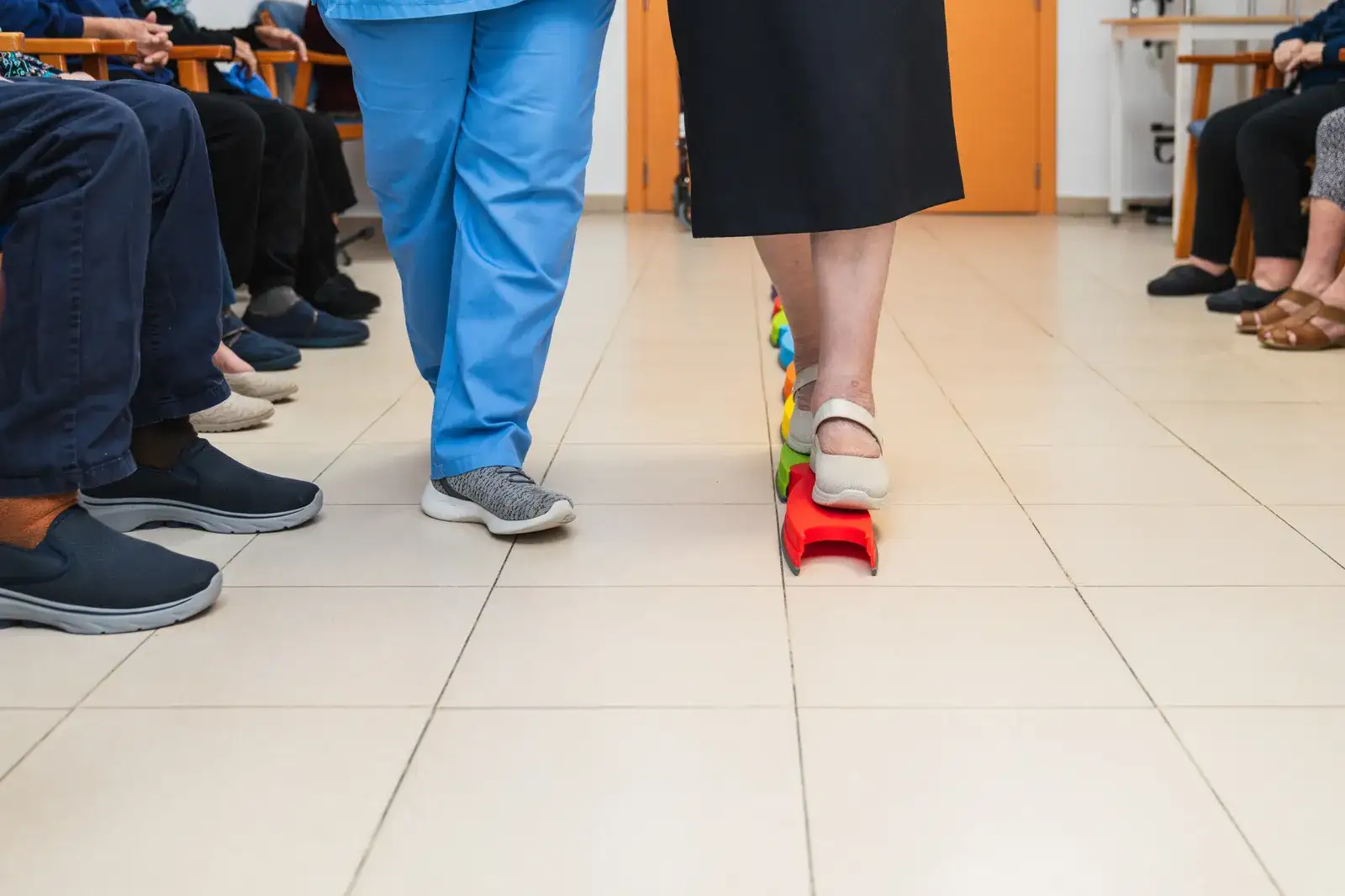
Amplitude-based training teaches big, exaggerated movements so everyday movement lands closer to normal size. Some branded programs, such as LSVT BIG, require the therapist to hold a specific certification. Cueing helps with freezing: stepping to a metronome beat, aiming for lines on the floor, or a deliberate weight shift before the first step. Strength work for the hips and trunk, often with a rack and cable system, supports chair rises and posture.
The goal is a routine you continue for years. After a course of care, many people move on to community exercise classes designed for Parkinson’s or to supervised strength training, like the options on the post-rehab strength training page.
- Large-amplitude walking and reaching practice
- External cues (metronome, floor lines, counting) for freezing
- Turning strategies for tight spaces
- Hip, thigh and trunk strengthening
- Reactive balance practice, including backward steps
- Aerobic conditioning on a bike, treadmill or the Monon Trail
How often should someone with Parkinson’s see a physical therapist?
Parkinson’s care usually comes in episodes rather than one long course: an initial block to set up a program, then periodic re-checks, often every 6 to 12 months or whenever walking, balance or falls change. Many neurologic therapists encourage a first evaluation soon after diagnosis, while movement is still good, so you start exercising early.
For Medicare beneficiaries, the Jimmo v. Sebelius settlement clarified that coverage of skilled therapy does not depend on showing improvement; skilled care to maintain function or slow decline can qualify when it requires a therapist’s skills. Details are on the Medicare physical therapy coverage page.
A common rhythm of care across the years looks like this, adjusted to how your symptoms change.
- Soon after diagnosis: a baseline evaluation and a starter routine of aerobic, strength and balance work.
- Initial block: often weekly or twice-weekly visits for 4 to 8 weeks to learn the program and set intensity.
- Between episodes: independent exercise toward the 150-minute weekly goal, in a class, gym or at home.
- Re-checks every 6 to 12 months: repeat tests, update the program, and address any new freezing or falls.
- After a fall or illness: a short focused block to rebuild confidence and strength.
Can I find a Parkinson’s-trained physical therapist near Carmel?
It depends on who is in the network at the time, because Parkinson’s rehab calls for neurologic training. Board certification in neurologic physical therapy from the American Board of Physical Therapy Specialties, or a Parkinson’s-specific program certification, is a good sign. After you complete the two-minute questionnaire, the matching team tells you honestly whether a therapist in the network offers this care, and if not, suggests what kind of program to look for.
If a match is available, sessions are one-on-one in a private suite at Carmel City Center, which suits people who freeze in crowded spaces. Garage parking is a short walk, and an early weekday appointment can line up with the strongest part of a medication cycle. Bring your medication list and anyone who helps you at home.
Ask any program you consider how they measure progress, how they adjust for “on” and “off” periods, and whether they will share results with your neurologist. A clear answer to each is a good sign of experience with the condition.
When to see a physician or go to the ER first
Physical therapy is the right start for most parkinson’s disease. These symptoms are different and need medical attention before, or instead of, a physical therapy visit:
- A fall with a head strike, or any fall while taking a blood thinner
- Sudden worsening of movement over days, which can signal infection or a medication problem
- New confusion, hallucinations or severe drowsiness
- Choking or coughing with most meals
- Fainting or near-fainting when standing up
- New weakness on one side of the body or slurred speech (call 911)
If you think it is an emergency, call 911.
Two-minute assessment
Get your parkinson’s disease looked at
Tell us how your parkinson’s disease started, how long it has been going on and what it is stopping you from doing. The matching team proposes a therapist in the network who focuses on it, and you hear back, usually within one business day.
- No referral needed to start in Indiana (first 42 days)
- We check which therapists work with your plan before you book
- One-on-one care in a private suite at Carmel City Center
How therapists treat it
Kinds of care used for parkinson’s disease
- Neurological physical therapyTask-focused rehab for stroke, Parkinson’s, MS and nerve conditions, tracked with standard balance and walking tests.
- Balance and fall preventionStrength, walking and balance training for older adults who feel unsteady, have fallen, or want to stay confident on their feet.
- Gait trainingWalking-focused rehab that measures speed and balance, then practises the steps, turns, stairs and surfaces you need for daily life.
Questions
Parkinson’s disease: what people ask
Information on this website is general education, not medical advice, a diagnosis or a treatment plan. Only a licensed clinician who examines you can advise on your condition. If you may be having a medical emergency, call 911.
Something we did not cover? Ask the matching team or ring (888) 353-9975.
Is it too early for physical therapy if I was just diagnosed with Parkinson’s?
Usually not. Many neurologic therapists recommend an evaluation soon after diagnosis to set a baseline and start an exercise routine while movement is still relatively easy.
Does exercise slow Parkinson’s disease?
Exercise reliably improves mobility, balance and quality of life in Parkinson’s. Whether it slows the underlying disease is still being studied, so it is more accurately described as essential treatment rather than a way to stop progression.
What helps with freezing of gait?
External cues such as stepping to a beat, aiming for a line on the floor, or a deliberate weight shift before stepping can help many people break a freeze. A therapist finds which cue works for you and practises it in your real trouble spots.
Should I time my sessions with my medication?
Often yes. Booking visits during reliable “on” time lets you train harder, while occasionally practising when medication is wearing off helps prepare for those moments at home.
Can Parkinson’s physical therapy help my voice or handwriting?
Voice is mainly a speech-language pathologist’s area and fine handwriting usually an occupational therapist’s. A physical therapist can coordinate with both.
Can I keep golfing or playing pickleball with Parkinson’s?
Many people do, and the turning, stepping and quick reactions these sports demand can be useful practice. A therapist can help you adapt footwork, balance and court positioning so the activity stays enjoyable and safer.
Google reviews
What guests say about FlexWerk
These are live Google reviews of FlexWerk at Carmel City Center, the private-suite facility where therapists in the network practise.
Related
Conditions that travel together
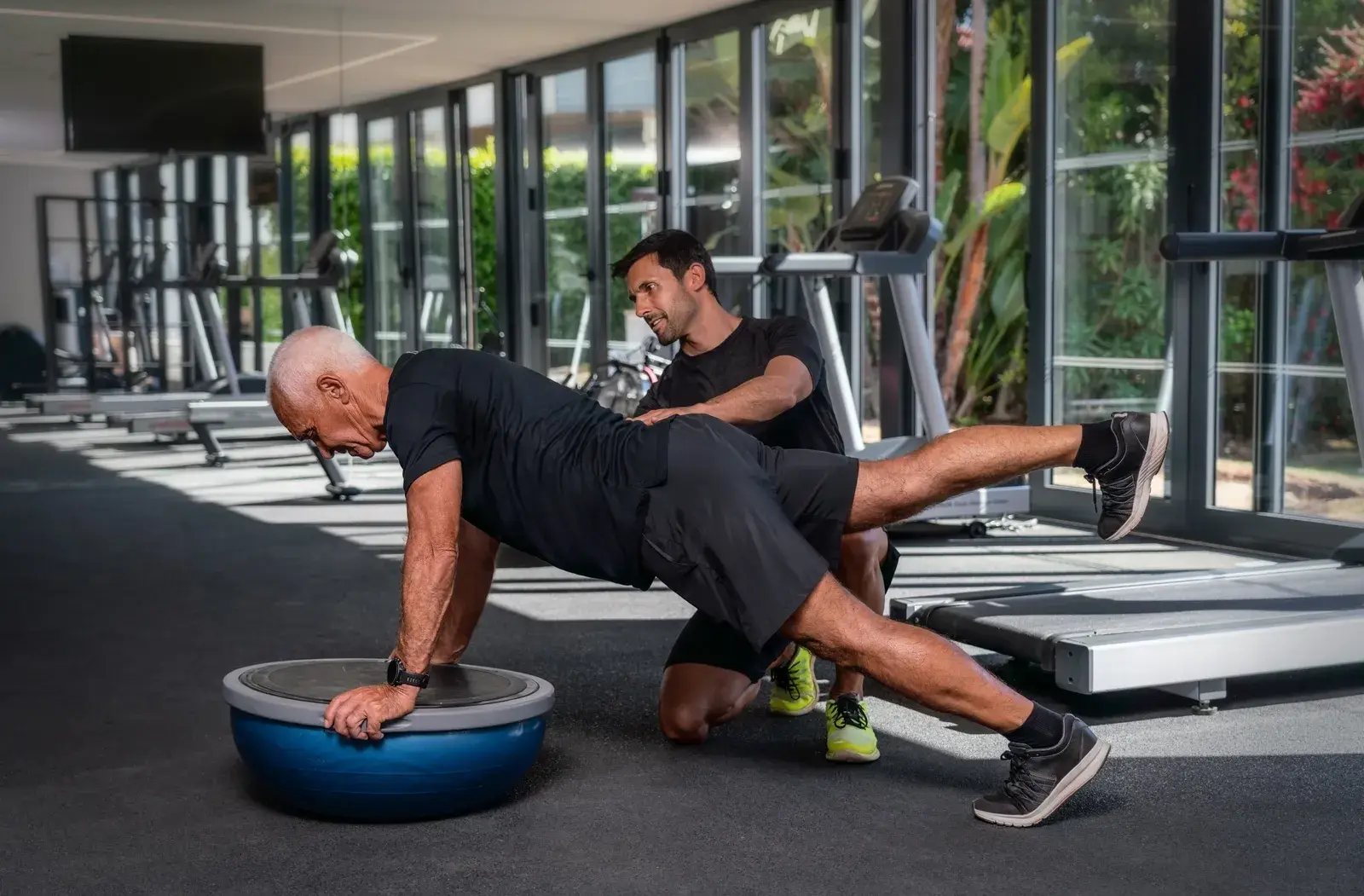 DeconditioningRebuilding strength, walking stamina and balance after a hospital stay, illness or long period of inactivity.
 OsteoporosisSupervised strength, balance and safe-movement training for people with low bone density or osteoporosis.
 Stroke recoveryOutpatient stroke rehab focused on walking intensity, balance, arm and leg use and family training, after hospital or home health care.
Page reviewed By the Monon Therapy Collective editorial team

Carmel City Center · Carmel, Indiana
Start with a conversation
Tell us what hurts and what you want to get back to. We will tell you honestly whether a therapist in the network is likely a good fit for what you describe, and match you with an independent, licensed therapist who is. Only that therapist can assess what will help.
885 Monon Green Blvd, Suite 120, Carmel, IN 46032 · Monday to Friday 5 AM to 9 PM · Saturday and Sunday 7 AM to 4 PM