Rehab after a patellar tendon repair usually starts with three to six weeks in a knee brace or immobilizer held straight, then a gradual unlocking of the knee bend, and months of quadriceps strengthening after that. OrthoInfo puts complete recovery at about six months, and many people need closer to twelve to reach every goal. Near Carmel, the matching team proposes an independent, Indiana-licensed physical therapist who follows your surgeon’s protocol one-on-one in a private suite at Carmel City Center.
Last reviewed By the Monon Therapy Collective editorial team
- Brace or immobilizer
- Commonly 3 to 6 weeks
- Full weight on the leg
- Often by 4 to 6 weeks, in the brace
- Complete recovery
- About 6 months; many need up to 12
- Sport clearance target
- At least 85 to 90% of the other leg’s strength
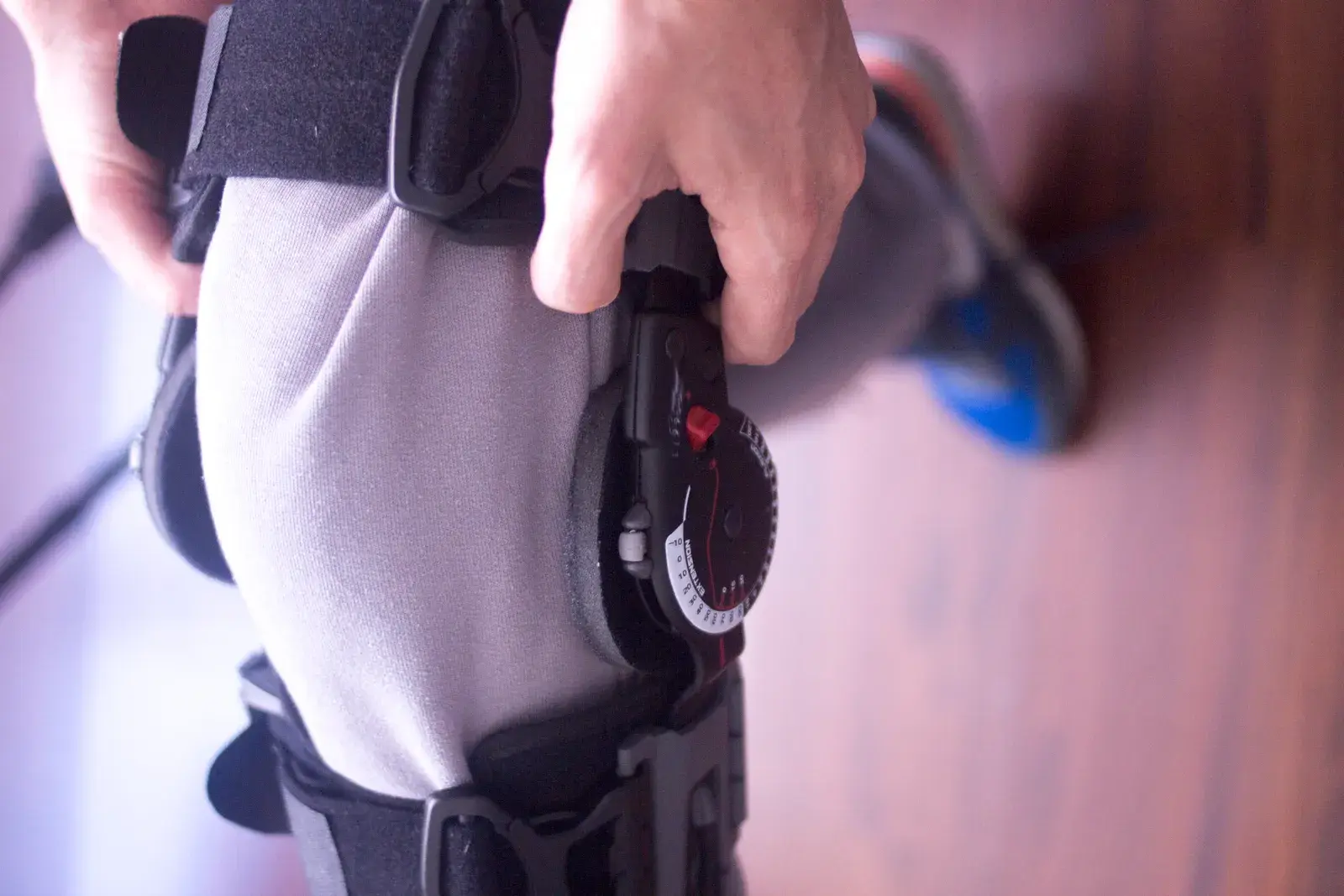
Why is the knee kept straight after the patellar tendon is sewn back?
The knee is held straight because bending it pulls the repaired tendon away from the kneecap, and the stitches need weeks of protection before the tendon can take that tension. The tendon links the kneecap to the shinbone, so every squat, stair and chair asks it to hold your body weight against a bent knee.
For that reason the first rule of this rehab is not to test the repair early. You will usually walk with the brace locked in extension and crutches, starting with toe-touch weight and building toward full weight by around four to six weeks, according to OrthoInfo. Straight-leg raises in the brace and quadriceps tightening keep the thigh from switching off while the tendon heals.
What are the stages of patellar tendon repair rehab, month by month?
Most protocols move through four broad stages, and progress depends on how the knee looks and feels, not only the date. The ranges below are typical; your surgeon’s written plan takes priority, especially if the tear was repaired with a graft or the tissue was poor quality.
| Time after surgery | Main goals | Typical milestones |
|---|---|---|
| 0 to 6 weeks | Protect the repair, control swelling, keep the quadriceps firing | Brace locked straight for walking; weight builds from toe touch to full; bend limits widen in steps |
| 6 to 12 weeks | Unlock and wean the brace, walk without a limp, regain the bend | Off crutches; a full turn on a stationary bike; standing on the operated leg |
| 3 to 6 months | Rebuild quadriceps strength and control on stairs and squats | Step-downs, leg press and split squats with steady loading |
| 6 to 12 months | Power, landing and running for those returning to sport | Strength close to the other leg, hop and agility drills, surgeon clearance |
Which brace settings and bending limits does the surgeon decide?
The surgeon decides how far the brace may unlock each week, when you may bear full weight, and when the brace comes off for walking. Those choices depend on how strong the repair felt in the operating room, whether the tear came off the kneecap or ripped mid-tendon, and the quality of the tissue.
Your therapist decides how to reach each goal inside those limits and checks that you have actually met it. A common example: if the protocol allows 60 degrees of bend at week three, the therapist works toward that range gently and reports back if the knee is far stiffer or looser than expected. Ask for the protocol at your first post-operative visit; the guide to talking to your surgeon about physical therapy lists questions worth bringing.
Why does quadriceps weakness linger so long after this repair?
The quadriceps lags because it was unloaded for weeks and because the tendon it pulls through was the injured part, so the brain tends to protect it by holding back effort. OrthoInfo lists weakness and loss of motion as the most common problems after the operation, which is why the middle months are mostly strength work.
Expect slow, measurable loading: leg press with a limited bend, step-downs from low boxes, wall sits and isolated knee extension once your surgeon allows it. The private suites have a rack, cable system and dumbbells, so loads can keep rising week to week. Many people with desk jobs find a 5 AM weekday session before work easier to protect over months than a lunchtime slot.
- Quadriceps sets and straight-leg raises from the first days
- Hip and calf strength so the knee is not doing all the work
- Controlled bending range, added only as the protocol opens it
- Single-leg strength and stair practice before any running
When do stairs, squats and jumping come back after a patellar tendon repair?
Stairs usually come back first, then deeper squats, then running and jumping, and each step depends on the bend and strength you have regained rather than a fixed week. Going up stairs needs less knee bend than coming down, so most people manage climbing with a rail well before a smooth descent.
Squatting below chair height asks the repaired tendon to work hard at a long length, so therapists build toward it through partial squats, box squats to a raised seat and split squats. Jumping and sprinting sit at the very end, because landing asks the tendon to absorb a large load in a fraction of a second. For basketball and volleyball players that last stage often runs into the second half of the first year.
- Climbing stairs with a rail: often once the brace is weaned and the bend is improving
- Descending stairs step over step: needs quadriceps control on a bent knee
- Deep squat and kneeling: commonly months later
- Running, jumping, cutting: only after strength testing and surgeon clearance
How can I prepare before patellar tendon surgery?
Because this tendon usually tears suddenly, from a fall onto the knee or an awkward landing, there is rarely time for formal prehab, and most repairs are done soon after the injury. Even a few days are enough to practise crutch walking with the leg straight, set up a chair with arms and a raised seat, and arrange rides, since a locked brace on the right leg rules out driving for a while.
If the tendon was already sore before it tore, often from patellar tendinitis, mention that history to your surgeon and therapist. It can change how cautiously the later loading is progressed.
How do I find a therapist near Carmel for patellar tendon rehab?
Start the two-minute physical therapy questionnaire, choose after surgery, and note the repair date, surgeon and whether you still wear a locked brace. A person on the matching team reads it and proposes an independent therapist in the network whose schedule and coverage fit, then hands you to that therapist’s office to confirm benefits and book.
Garage parking at Carmel City Center is a short walk from the suites, so mention if you are still on crutches and the team can tell you what to expect on arrival. The general post-surgical rehabilitation page covers the principles shared with other operations, and the quadriceps tendon repair rehab guide covers the tendon just above the kneecap.
Call your surgeon promptly after patellar tendon repair if
- You feel a pop and suddenly cannot lift the straight leg again
- The kneecap looks or feels higher than it did at your last check
- Calf pain, swelling or warmth in the operated leg
- Chest pain or shortness of breath: call 911
- Fever, or a wound that is red, hot or draining
- Pain or swelling that keeps climbing instead of settling
If you think it is an emergency, call 911.
