Rehab after a kneecap (patella) fracture usually starts with walking in a brace or immobilizer locked straight, then regains bend gradually and rebuilds the thigh muscle that pulls across the kneecap. AAOS OrthoInfo says most people return to normal activities within three to six months, with severe fractures taking longer. In the Carmel area, the matching team can propose an independent, Indiana-licensed physical therapist for this, whether the kneecap was repaired with wires, screws or a plate or treated in a brace.
Last reviewed By the Monon Therapy Collective editorial team
- Early walking
- In a brace locked straight, often 2 to 4 weeks
- Normal activities
- Usually 3 to 6 months
- Common lasting issue
- Thigh weakness and pain with kneeling
- Hardware
- Sometimes removed after healing
Why does a broken kneecap affect straightening the leg so much?
The kneecap sits inside the tendon system that straightens the knee, so a break can interrupt the pull of the thigh muscle on the shin. When the pieces separate, many people cannot lift the straight leg at all, which is one reason displaced fractures are usually fixed surgically.
OrthoInfo describes several repairs: a figure-of-eight tension band of wires for a break across the middle, screws and wires for two-part or multi-piece fractures, small plates, sutures, and removal of fragments too small to fix (partial patellectomy). Stable fractures, where the pieces have barely moved, are often treated in a cast or brace without surgery.
Whichever route you took, the early rule is similar: protect the kneecap from the strong pull that bending creates while the bone knits. That is why the brace stays locked in the first weeks, even though you can usually put full weight through the leg in it.
Because the injury is sudden there is no chance for prehab, but the first visit after the brace is fitted can still cover practical things: getting in and out of a car with a straight leg, managing stairs one step at a time, and keeping the hip and ankle strong while the knee is protected.
How much can I bend my knee in the weeks after a patella fracture?
Bend is usually reintroduced in planned stages once your surgeon is happy with the fixation, often a set number of degrees at a time. OrthoInfo notes that you can typically put full weight on the leg in an immobilizer or brace locked straight for two to four weeks, depending on the surgeon.
The ranges below are typical rather than promised. A multi-piece fracture, a partial patellectomy or a repair in poor-quality bone often moves more slowly.
| Time after injury or surgery | Main goals | Typical milestones |
|---|---|---|
| 0 to 4 weeks | Protect the kneecap, control swelling, keep the leg straight | Walking in a locked brace, quad sets, ankle pumps |
| 4 to 8 weeks | Gradual bending, wean off the brace as allowed | Bend increasing week by week, bike with a high seat |
| 8 to 12 weeks | Full walking, early strength through a wider range | Normal walk, partial squats, step-ups |
| 3 to 6 months | Thigh strength, stairs, kneeling practice | Step-downs, leg press, return to most activities |
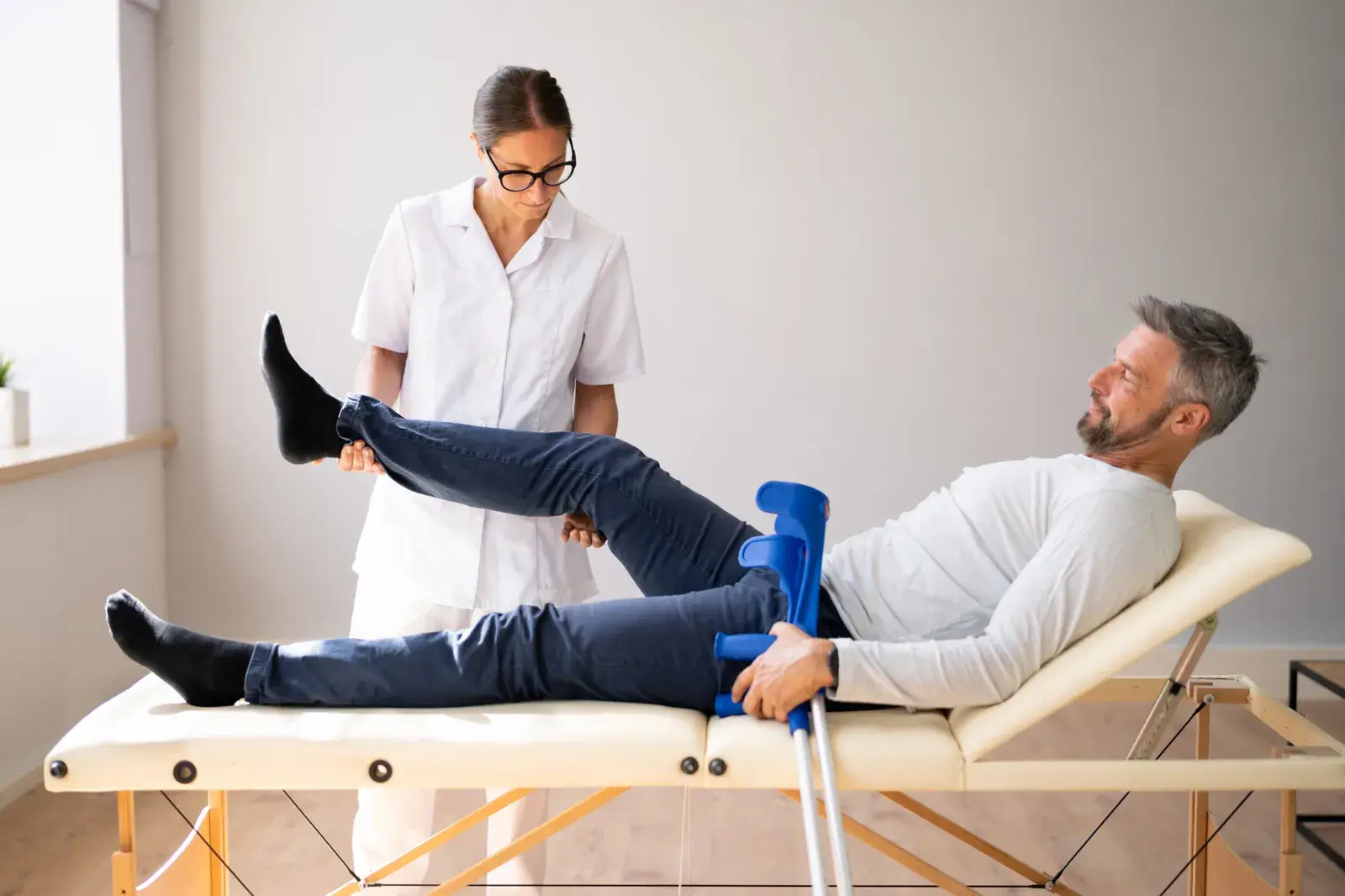
What does a straight-leg raise tell a therapist after a kneecap fracture?
A straight-leg raise shows whether the thigh muscle can lock the knee fully straight and lift the leg without the knee sagging, which therapists call an extensor lag. It is one of the simplest ways to check that the repaired kneecap is transmitting the muscle’s pull properly.
Early on, many people can only tighten the muscle; the lift comes later. A therapist may use electrical muscle stimulation, biofeedback or simple cues such as pushing the back of the knee into a rolled towel to help the muscle fire. The terminal knee extension exercise works the last few degrees of straightening, which are often the weakest after a patella fracture.
If a lag that had disappeared comes back suddenly, or you felt a pop, contact your surgeon, because it can mean the fixation has shifted.
Why does kneeling hurt for so long after a broken kneecap?
Kneeling presses directly on the healed bone, the scar and sometimes the wires or screws underneath, so it is commonly the last activity to feel normal. OrthoInfo lists chronic knee pain, hardware irritation and arthritis behind the kneecap among the possible long-term effects.
Therapists usually build tolerance gradually: kneeling on a thick cushion for short periods, then a thinner one, alongside strength work that takes load off the front of the knee. If hardware is the main source of irritation once the bone has fully healed, your surgeon may offer to remove it. The knee pain when kneeling page explains other reasons kneeling can hurt.
Stairs follow a similar pattern. Going up usually returns first; going down a long staircase asks the thigh to lower your body weight over a bent knee, which is exactly the job a patella fracture disrupts, so step-down practice at gradually greater heights tends to fill the last months of rehab.
What does the surgeon decide after a patella fracture repair?
Your surgeon decides the brace settings, how quickly bending is allowed, when X-rays are repeated and whether any hardware should come out later. Those choices depend on how many pieces there were and how secure the fixation is, which only the surgeon saw.
Your physical therapist measures bend, swelling and thigh control at each visit, adjusts the exercises, and contacts the surgeon’s office when progress stalls or the knee behaves unexpectedly. The post-surgical rehabilitation service describes how that cooperation usually works.
- Weight bearing and brace lock: surgeon
- Weekly bend limits: surgeon
- Exercise selection and load: therapist
- Hardware removal: surgeon, after healing
How do I arrange physical therapy for a kneecap fracture near Carmel?
Complete the after-surgery questionnaire and include the injury date, whether you had surgery and your surgeon’s name. A person on the matching team proposes an independent therapist in the network whose schedule and coverage fit, and the therapist’s office confirms benefits before booking.
A patella fracture often follows a fall onto the knee, sometimes on ice in winter or during a slip on a hard floor. If the fall itself worries you, mention it, because balance work can be built into the later stages of rehab. Weekend suite hours of 7 AM to 4 PM help people who cannot leave work during the week.
For people who lift, play pickleball or run on the Monon Trail, it helps to name the activity you most want back. A therapist can then work backward from it: a runner needs single-leg hopping and landing control, a lifter needs deep squats with load, and a gardener needs comfortable kneeling and getting up from the ground.
Call your surgeon soon after a kneecap fracture if
- You suddenly cannot lift the straight leg after being able to
- The wound is red, hot, draining or you have a fever
- Calf pain, warmth or swelling develops in the injured leg
- Chest pain or sudden breathlessness occurs: call 911
- Wires or screws feel newly prominent, or the knee gives way
If you think it is an emergency, call 911.
