Rehab after a distal biceps repair, which reattaches the biceps tendon to the forearm bone at the elbow, usually begins with a splint, moves to a hinged brace that gradually allows more straightening, and adds light resistance only after several weeks. OrthoInfo notes the tendon needs more than three to four months to heal fully and that heavy activities and manual labor typically resume after four to six months. Near Carmel, the matching team suggests an independent, Indiana-licensed physical therapist in the network who works one-on-one in a private suite and follows your surgeon’s protocol.
Last reviewed By the Monon Therapy Collective editorial team
- Right after surgery
- Cast or splint
- Early motion
- Commonly in a hinged brace
- Tendon fully healed
- More than 3 to 4 months
- Heavy lifting and manual labor
- Often after 4 to 6 months
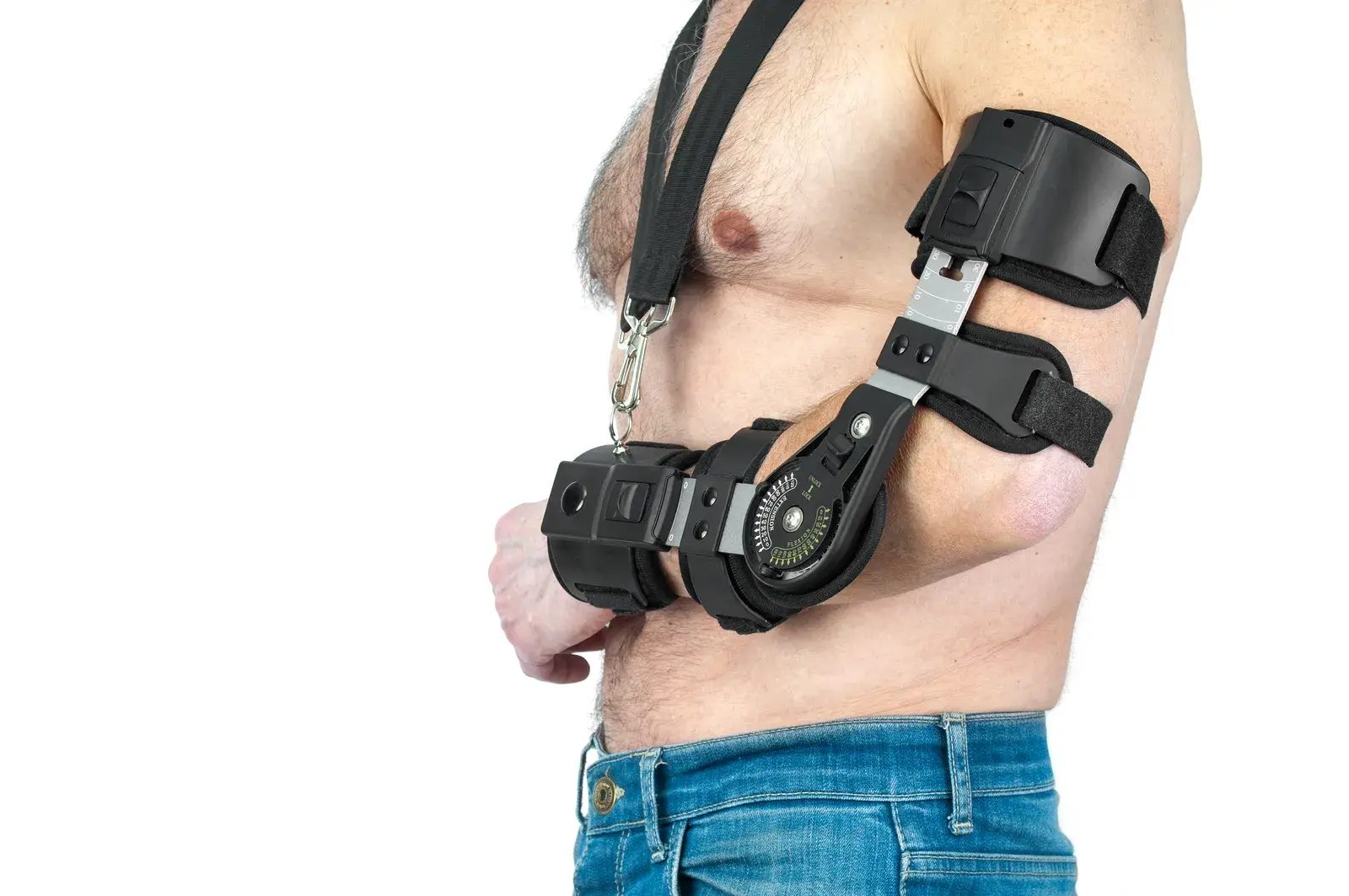
Why is the elbow kept bent at first after a biceps tendon repair?
Straightening the elbow and turning the palm down both stretch the biceps tendon, so the arm starts in a bent position to keep tension off the new attachment. Over the following weeks a hinged brace is set to allow a little more straightening at a time.
The other movement the biceps controls is turning the palm up, called supination, as when you turn a screwdriver or a doorknob. Early protocols usually allow gentle, unresisted motion and forbid lifting, carrying or forceful twisting, because the tendon-to-bone connection is weakest before it heals.
What are the stages after distal biceps repair, month by month?
Most protocols follow a protect, move, strengthen pattern over four to six months. The ranges below are typical; your surgeon’s version takes priority, especially if the repair was delayed or used a graft.
| Time after surgery | Main goals | Typical milestones |
|---|---|---|
| 0 to 2 weeks | Protect the repair, control swelling, keep the hand and shoulder moving | Splint; finger, wrist and shoulder motion |
| About 2 to 6 weeks | Gradually regain elbow motion in a hinged brace | Straightening limit eased in steps; gentle palm-up and palm-down motion |
| About 6 to 12 weeks | Full motion, light strength | Brace weaned; light bands and small weights as allowed |
| About 3 to 6 months | Progressive strength and work or sport demands | Heavier lifting and manual work often around 4 to 6 months |
What do the surgeon’s brace and lifting rules cover?
The surgeon sets the brace settings, how quickly straightening may increase, when resistance may start, and when you may return to heavy lifting or manual work. Those choices depend on how the tendon was fixed to the bone, how long after the injury the repair was done, and the quality of the tendon.
Your therapist decides the exercises inside those limits and checks that the elbow is not drifting toward a stiff, permanently bent position, a recognized risk whenever an elbow is held bent for weeks. If straightening stalls, the therapist will discuss it with the surgeon rather than force it.
Is numbness in the forearm normal after distal biceps surgery?
Some numbness or tingling along the outer forearm is a recognized and usually temporary effect, because a small sensory nerve runs close to where the surgeon works. OrthoInfo notes numbness or weakness in the forearm, wrist or hand usually resolves.
Tell your surgeon about any numbness, and especially about new weakness in the wrist, thumb or fingers, so it can be followed. OrthoInfo also lists new bone forming near the attachment and, uncommonly, re-rupture as possible complications; a therapist watches for loss of rotation that might point to the first of these.
How is strength rebuilt for lifting and work after a biceps repair?
Strength returns in stages: isometric holds, then light bands and dumbbells for bending the elbow and turning the palm up, then heavier compound pulls such as rows and eventually chin-ups or deadlifts if those are your goal. The aim is to match the other arm before full heavy work.
For weightlifters, contractors and anyone who carries for a living, a private suite with a rack, cable system and dumbbells allows loads to rise in measured steps. The weightlifters and tradespeople pages cover the demands of each group.
- Isometric holds with the elbow at different angles
- Light curls and palm-up turns with bands or dumbbells
- Rows and pulls with gradually heavier loads
- Carrying and lifting practice matched to your job
What daily tasks are off limits in the first weeks after a biceps repair?
In the early weeks, avoid anything that loads the biceps against resistance: lifting a full kettle or grocery bag, pushing up from a chair with the operated arm, opening tight jars, turning a key or doorknob firmly, and carrying a bag on that side. Even a light object held at arm’s length puts more tension on the tendon than most people expect.
Typing, eating with the other hand and light personal care are usually fine within the brace rules. When you get up from a chair or out of bed, push with the other arm. Your therapist will go through your own day, from the commute to the gym bag, and help you find one-handed ways to do what you cannot avoid until the surgeon lifts the restrictions.
- No lifting, carrying or pushing up with the operated arm
- No forceful twisting such as jars, keys or screwdrivers
- Push up from chairs with the other arm
- Light typing and self-care within the brace limits
Is there time for anything before distal biceps surgery?
Repairs are usually done soon after the injury because the tendon can retract and scar, so there is little time for formal prehab. The useful steps are practical: arranging help for the first weeks of one-handed life, especially if the dominant arm is involved, and planning time off from heavy work.
If you are unsure whether you injured the tendon, a sudden pop at the front of the elbow followed by a bulge higher in the arm is the classic story, and it should be seen by a physician promptly. The biceps tendinitis page covers irritation without a tear, and the biceps tenodesis rehab guide covers surgery at the shoulder end.
How do I begin biceps repair rehab near Carmel?
Complete the physical therapy questionnaire, choose after surgery and add the date and brace settings. A person on the matching team suggests a therapist in the network, and that therapist’s office confirms your benefits and books.
Suites open at 5 AM on weekdays, which suits people who want to keep working through the weeks in a brace; garage parking is a short walk away.
Call your surgeon after a distal biceps repair if
- A pop at the elbow followed by new pain or a change in the shape of the arm
- New weakness of the wrist, thumb or fingers
- Fingers that are cold, pale or very swollen
- Fever, or an incision that is red, hot or draining
- Chest pain or shortness of breath: call 911
If you think it is an emergency, call 911.
