Rehab after bunion surgery focuses on getting the big toe joint to bend again, restoring a normal push-off through the ball of the foot, and managing swelling that the American Academy of Orthopaedic Surgeons says commonly lasts six months to a year. Full recovery often takes up to six months. In Carmel, the matching team can connect you with an independent, licensed physical therapist for one-on-one sessions in a private suite at Carmel City Center once your surgeon allows it.
Last reviewed By the Monon Therapy Collective editorial team
- Dressings or brace
- 6 to 12 weeks of support (AAOS)
- Stitches out
- About 2 weeks
- Swelling
- Common for 6 months to 1 year
- Full recovery
- Often up to 6 months
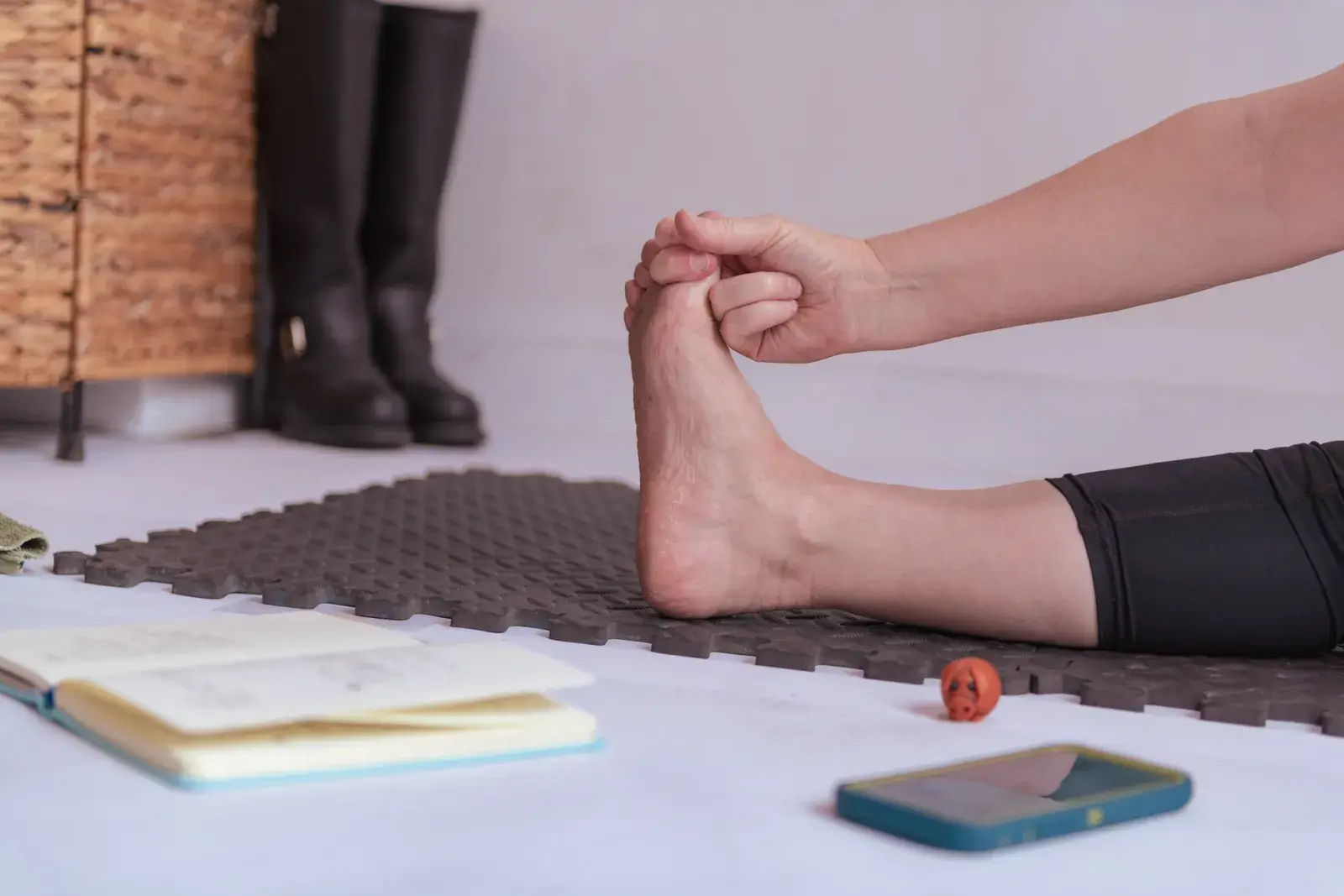
What changes in the foot after a bunion is corrected?
After a bunion correction, the first metatarsal (the long bone behind the big toe) and often the toe itself sit in a new position, held by screws, a plate or a fusion. The joint at the base of the big toe has been operated near or on, so it is usually stiff, swollen and reluctant to bend upward when you step through.
A bunion, or hallux valgus, is a bony bump at the inside of the big toe joint that forms as the toe angles toward the second toe. OrthoInfo explains that surgery is usually considered when the bunion is painful despite wider shoes, pads and anti-inflammatory medicine, not to prevent it from growing. There are many different procedures, which is why recovery advice varies so much between people who look like they had the same operation.
The rehab target is simple to describe and slow to reach: a big toe that bends back far enough for you to roll over it, and a foot that loads the ball of the big toe again instead of rolling to the outside to avoid it.
How long until you are out of the surgical shoe and walking normally after bunion surgery?
Many people spend several weeks in a surgical shoe or boot and then begin moving into a roomy athletic shoe, but the range is wide. OrthoInfo says the foot needs continued support from dressings or a brace for 6 to 12 weeks, and some procedures need a period of no weight bearing on crutches or a knee scooter first.
| Time after surgery | Goals | Typical milestones |
|---|---|---|
| 0 to 2 weeks | Protect the correction, limit swelling | Foot elevated most of the day; surgical shoe or boot; weight bearing only as cleared; stitches out around 2 weeks |
| 2 to 6 weeks | Keep the rest of the leg working, start gentle toe motion if allowed | Short walks in the shoe or boot; ankle and knee movement; seated hip work |
| 6 to 12 weeks | Restore big toe bend and a normal step | Transition to a wide, stiff-soled shoe; joint mobility work; calf and foot muscle strengthening |
| 3 to 6 months | Walking distance, standing tolerance, light impact | Longer walks; heel raises through the big toe; jogging only when cleared |
| 6 to 12 months | Residual swelling settles | Most shoe choices tolerated; swelling may still vary with heat and long days |
What does physical therapy add after a bunionectomy that home exercises do not?
It adds measurement and progression. A physical therapist can measure how far the big toe bends, watch where your weight travels through the foot, and push the joint’s mobility and strength forward at a pace your surgeon allows, which is hard to judge by yourself when the foot is sore and swollen.
Hands-on mobilization of the big toe joint is often part of it, as is retraining the small muscles under the arch. The short foot exercise, where you shorten the arch without curling the toes, is one example a therapist may use. Calf strength matters too, because a weak calf cannot drive a strong toe-off even when the joint moves well.
Many people walk on the outside of the foot for weeks to protect the big toe, and that habit can leave the outer foot or the ankle sore. Gait practice in front of a mirror, short walks on the indoor turf corridor, and heel raises with the weight deliberately centered over the big toe help unwind it.
- Big toe joint mobility, by hand and with active bending
- Toe yoga: lifting the big toe while the small toes stay down, and the reverse
- Heel raises keeping pressure on the ball of the big toe
- Balance on the operated foot once fully weight bearing
- Scar mobility and swelling control
When can you run, play pickleball or golf again after bunion surgery?
Walking-based activities such as golf usually come back first, once you walk comfortably in a regular shoe and your surgeon agrees, while running and court sports tend to wait until the bone has fully healed and the big toe bends well enough for a strong push-off. Your surgeon’s clearance comes first, and many people need closer to six months for comfortable impact.
Golf asks the trail foot to roll onto the big toe at the finish of every swing, so a stiff joint shows up quickly; shorter rounds with a cart are a common bridge. Pickleball adds quick lateral steps and sudden stops that load the forefoot hard, which is why a therapist usually checks single-leg heel raises, hopping and side shuffles before you return to the courts. A running return usually follows a walk-run plan on flat ground first.
Which parts of bunion recovery does the surgeon control?
The surgeon controls weight bearing, footwear, when you may get the foot wet and when the toe may be moved forcefully. Some corrections are stable enough to walk on in a protective shoe right away; others, especially fusions or corrections higher up the metatarsal, need weeks with no weight on the foot so the bone does not shift.
If you had a fusion of the big toe joint, there is no bending at that joint to restore, so therapy focuses on the ankle, calf, gait and the joints that remain. Bring your operative report to the first visit so the therapist knows exactly what was done. If you were told your big toe pain is arthritis rather than a bunion, our page on hallux rigidus explains that related problem.
What can you do before bunion surgery to make the first weeks easier?
Prehab before a bunion correction is mostly about the weeks when you cannot use the foot normally. Practice with crutches or a knee scooter, strengthen the hips and the other leg, and set up a place to rest with the foot raised above heart level, close to a bathroom.
Plan footwear too. Choose a pair of wide, soft-toed athletic shoes for the transition months and expect some swelling in them. OrthoInfo also warns that returning to the narrow shoes that contributed to the bunion can bring it back. When outpatient therapy is advised, the two-minute questionnaire lets the matching team note your surgery date and limits. Our page on ball of foot pain helps if that area aches as you return to longer walks.
Call your surgeon promptly after bunion surgery if you notice
- Toes that look pale, blue or feel cold and numb
- Increasing redness, warmth, drainage or an opening wound, or a fever
- Calf pain and swelling, or chest pain or shortness of breath (call 911 for breathing symptoms)
- A sudden change in the toe’s position, or new severe pain after a misstep
If you think it is an emergency, call 911.
