Plan on several months. OrthoInfo describes a sling for about 4 to 6 weeks with therapist-guided passive motion, active exercise after that, strengthening from roughly 8 to 12 weeks, and functional range of motion and adequate strength for most people by 4 to 6 months. Heavier lifting, overhead work and sport often take longer and are cleared by your surgeon. The pace is set by how fast the repaired tendon heals back onto bone, not by how the shoulder feels.
Last reviewed By the Monon Therapy Collective editorial team
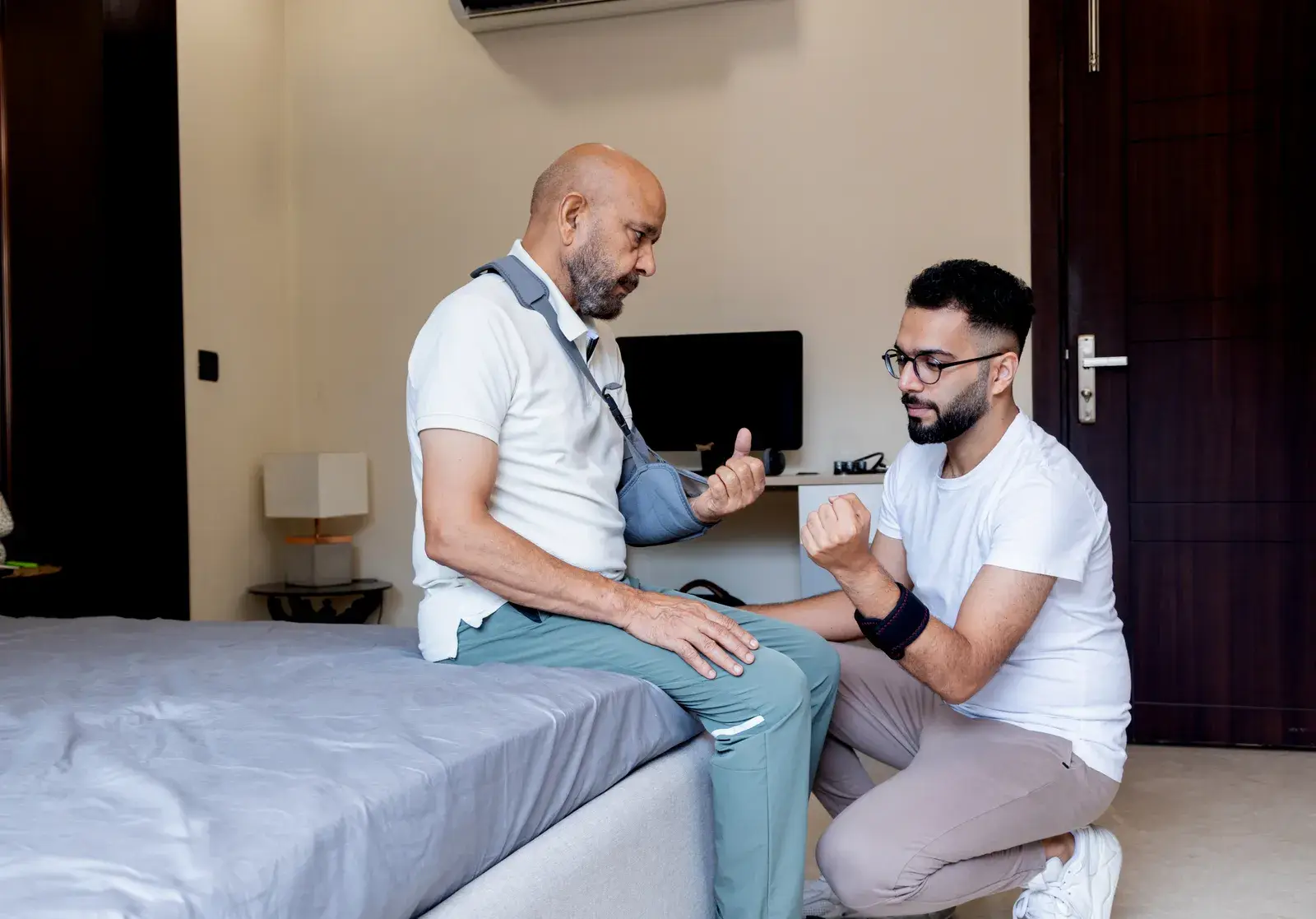
Why does a repaired rotator cuff take months to heal?
Because the surgeon has stitched tendon back onto bone, and that attachment takes months to mature. For the first several weeks the repair relies on stitches and anchors while the body starts to lay down new tissue. Pulling hard on the tendon during that time risks the repair failing.
That is why recovery feels slow even when pain settles. Many people feel surprisingly comfortable a few weeks in and are tempted to use the arm, but the tendon is at its weakest in that period. OrthoInfo notes that larger tears carry a higher chance of the tendon tearing again, so surgeons tend to be more cautious with big repairs.
What happens month by month after rotator cuff repair?
The outline below follows the stages OrthoInfo describes. Exact timing depends on the size of the tear, the quality of the tendon and the type of repair, so your surgeon’s protocol may move each step earlier or later.
Do not judge progress by comparing with a friend’s surgery. A small repair in a young, healthy tendon and a large repair in an older, thinner tendon follow different calendars, and both can end well.
- Weeks 0 to 6: arm in a sling; a therapist moves the shoulder passively while the muscles rest; elbow, wrist and hand exercises at home
- Weeks 4 to 12: the sling comes off and you begin moving the arm under your own power, first with help from the other arm, then on its own
- From about weeks 8 to 12: strengthening begins with light resistance, such as a band for external rotation, and shoulder blade control
- Months 4 to 6: most people reach functional motion and adequate strength for daily life
- Beyond 6 months: heavier lifting, overhead work and sport, as cleared by your surgeon
When can I drive, sleep normally and go back to work after rotator cuff surgery?
Driving waits until you are out of the sling and off opioid pain medicine, and your surgeon agrees you can control the wheel with both hands. For most people that is weeks, not days. Sleep is often the hardest part early on, and many people find a recliner or a stack of pillows more comfortable than lying flat for the first few weeks.
Work depends on the job. Desk work one-handed can sometimes resume within a week or two, with your surgeon’s approval, while jobs that involve lifting, reaching overhead or climbing ladders may need several months. Ask your surgeon for written restrictions your employer can follow, and ask your therapist to work on the specific tasks your job involves once strengthening begins.
Daily tasks need small workarounds in the sling weeks. Loose, front-opening shirts, a pump soap dispenser, meals that can be eaten one-handed and a shower chair all reduce the temptation to use the operated arm. Setting these up before surgery is far easier than improvising afterward.
What does physical therapy do at each stage of recovery?
Early on, therapy protects the repair while preventing stiffness. OrthoInfo notes that early rehabilitation lessens the chance of permanent stiffness or loss of motion, which is why passive range of motion starts while you are still in the sling. Your therapist also checks how you are sleeping, managing the sling and handling daily tasks one-handed.
Later, the work shifts to strength and control of the whole shoulder: rotator cuff, shoulder blade muscles and the upper back. Once strength is solid, a therapist adds the demands of your life, whether that is lifting a toddler, swinging a golf club or reaching into a kitchen cupboard. Our rotator cuff repair rehab guide sets out the phases in more detail.
When can I play golf or pickleball again after rotator cuff surgery?
Usually not before the later strengthening phase, and only with your surgeon’s clearance. Chipping and putting often come back first, then gradually longer swings. Pickleball asks for quick overhead reaches and sudden stops, so a therapist usually rebuilds strength and endurance in those positions before you play a full game.
With Carmel’s golf season running roughly spring through fall, it is worth planning surgery timing with the season in mind if you have a choice. For guidance after discharge, post-rehab strength training bridges the gap between therapy and full play. To find a therapist in the network for shoulder rehab, start the two-minute questionnaire.
Related questions
Is rotator cuff surgery recovery painful?
The first few weeks are usually the most uncomfortable, especially at night. Pain generally eases steadily, and your surgeon manages medication. Therapy sessions should feel like work, not sharp pain.
What happens if I move my arm too much too soon?
You risk stressing the repair before the tendon has healed. If you have a fall or a sudden painful jerk of the arm, contact your surgeon, who may want to examine it.
Can a repaired rotator cuff tear again?
It can. OrthoInfo notes re-tears are more likely with larger tears, though many re-tears do not cause more pain or loss of function. Following the protocol lowers the risk of a re-injury in the early months.
How is surgery recovery different from healing a tear without surgery?
Without surgery, therapy works on strength around the tear from the start. After repair, the early months focus on protecting the tendon. See how long a rotator cuff tear takes to heal for the nonsurgical timeline.
How often will I see a physical therapist after rotator cuff repair?
Visits are often one to three times a week, depending on the phase and your surgeon’s protocol, with home exercises on the other days. Frequency usually rises when active motion and strengthening begin, then tapers as you become independent.
Keep reading
- How long does a rotator cuff tear take to heal?
- Do I need surgery for a torn rotator cuff?
- How soon after surgery should I start physical therapy?
- Rotator cuff repair rehab in Carmel
- Rotator cuff injury physical therapy in Carmel
- Post-surgical rehabilitation in Carmel
This page is general education, not medical advice. A physical therapist can only advise on your situation after an examination.
