Rehab after a shoulder replacement depends on which kind you had. An anatomic total shoulder relies on a healthy rotator cuff and protects the front tendon that was cut and repaired, while a reverse shoulder replacement lets the deltoid muscle lift the arm and guards against certain positions that can dislocate it. Either way, most people wear a sling for two to six weeks and avoid extreme arm positions for about six weeks; near Carmel, the matching team proposes an independent, Indiana-licensed therapist who follows your surgeon’s protocol one-on-one in a private suite.
Last reviewed By the Monon Therapy Collective editorial team
- Sling
- 2 to 6 weeks, per your surgeon
- Eating, dressing, grooming
- Often within about 2 weeks
- Driving
- Usually not for 2 to 6 weeks
- Extreme positions
- Avoided for about 6 weeks
Did I have an anatomic or a reverse shoulder replacement, and why does it matter for rehab?
It matters because the two operations rely on different muscles, so the early protections and later exercises differ. An anatomic total shoulder replacement copies the normal ball-and-socket and needs an intact rotator cuff to work; a reverse total shoulder replacement swaps the ball and socket so the deltoid, the large muscle over the shoulder, can lift the arm when the rotator cuff no longer can.
OrthoInfo describes the reverse design as a choice for people with a badly torn cuff, cuff tear arthropathy, some complex fractures, or a failed earlier replacement. A conventional one is more typical for osteoarthritis with a working cuff, the kind described on the shoulder arthritis page.
Your operative report names the implant and the approach. Bring it, or ask your surgeon’s office to send it to the therapist’s office, before the first visit. A therapist who knows whether the subscapularis was repaired, and how the implant sat in the bone, can pace the early weeks far more precisely than one working from a general handout.
Which arm positions are off limits after a shoulder replacement?
For about the first six weeks, most surgeons ask you to avoid extreme positions, especially the arm straight out to the side or reaching behind your body. OrthoInfo also advises lifting nothing heavier than a glass of water for the first two to six weeks, until the surgeon lifts that limit. The exact list depends on the type of replacement.
After an anatomic replacement, the subscapularis tendon at the front of the shoulder is usually detached and repaired, so turning the arm outward and pushing with the hand (for example, pushing up from a chair) are restricted early. After a reverse replacement, the riskiest combination is reaching behind the back with the arm turned inward, the motion of tucking in a shirt or reaching for a back pocket, which can pull the joint apart in the early months.
- No pushing up from a chair or bed with the operated arm early on
- No reaching behind the back, especially after a reverse replacement
- No lifting more than a light cup until the surgeon allows
- Keep the elbow in view, slightly in front of the body, when lying down
What is the recovery timeline after anatomic or reverse shoulder replacement?
Expect a protected first six weeks, a motion and light-use phase to about three months, and strength gains for several months after that. These are typical ranges; your surgeon’s protocol sets the real dates.
| Time after surgery | Goals | Typical milestones |
|---|---|---|
| Weeks 0 to 2 | Protect the joint, control pain, gentle passive motion | Sling on, hand and elbow exercises, simple self-care with the other arm |
| Weeks 2 to 6 | Passive and assisted motion within limits | Eating, dressing and grooming with the operated arm at waist level |
| Weeks 6 to 12 | Active motion, early strength, everyday reach | Sling off, driving if cleared, reaching shelves at shoulder height |
| Months 3 to 6+ | Strength and endurance for home tasks and hobbies | Golf, swimming, gardening as the surgeon permits |
What does the shoulder surgeon decide, and what does the therapist adjust?
The surgeon decides the sling time, the forbidden positions and when they end, lifting limits, driving, and long-term activity rules; OrthoInfo, for example, advises against contact sports and repetitive heavy lifting after a shoulder replacement. Those limits protect the implant and any repaired tendon.
Your therapist adjusts the work inside those limits: how far to move the arm passively, when to add assisted reaching with a dowel or pulley, how to strengthen the deltoid and shoulder blade muscles, and how to cope with stiffness or night pain. After a reverse replacement, deltoid strength and shoulder blade control carry most of the long-term function, so they get steady attention.
How do outpatient sessions progress once the sling comes off?
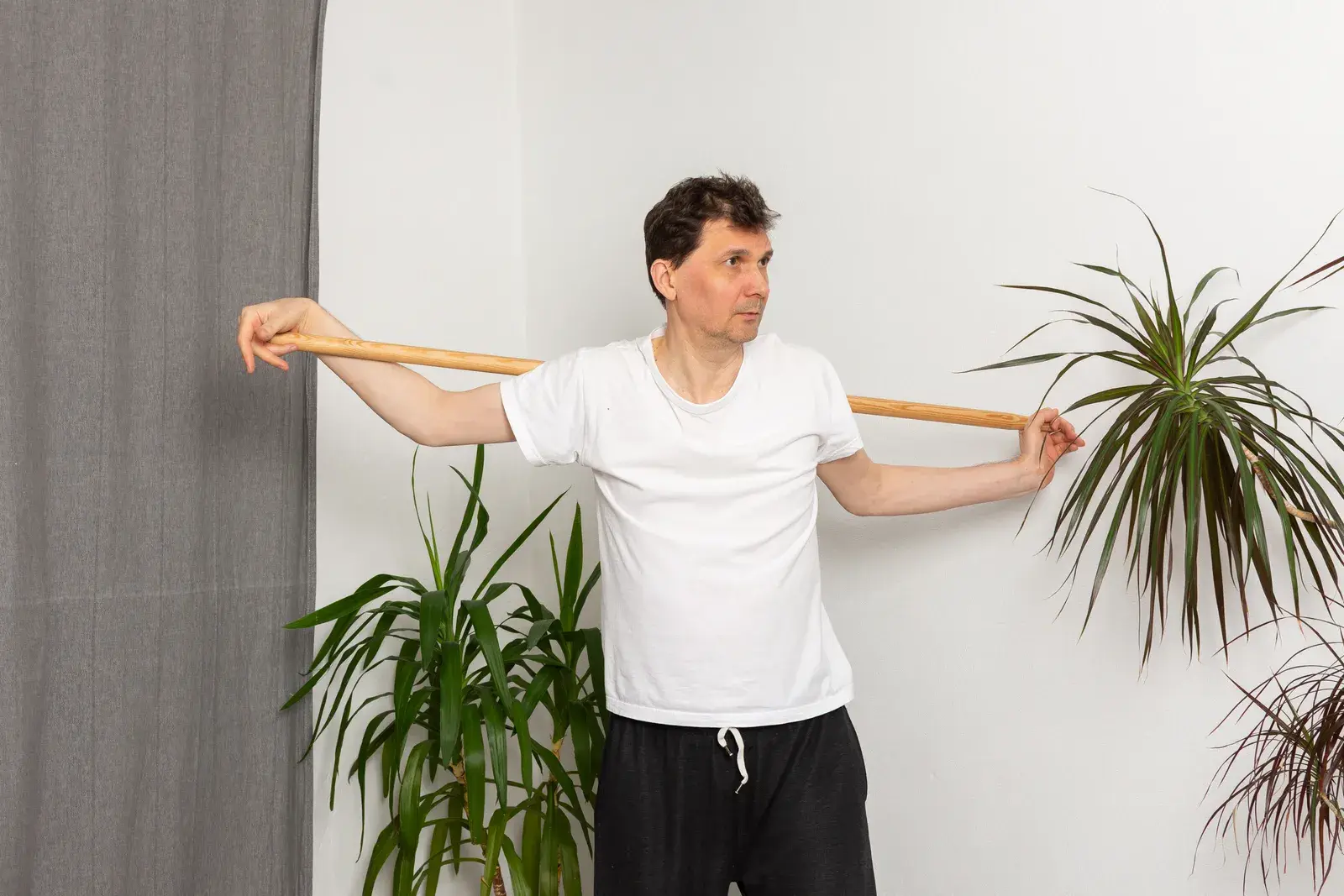
Once the sling is off, sessions shift from passive motion to the arm moving under its own power, usually starting lying down, where gravity helps, and progressing to sitting and standing. A dowel or stick held in both hands lets the good arm help the operated one lift, a common bridge between assisted and active motion.
Later, the cable system and light dumbbells in the private suites allow small, measured increases in load, and wall work such as the shoulder wall slide builds controlled overhead reach when your protocol allows. The aim is practical: reaching a cupboard, washing your hair, carrying groceries from the City Center garage to the car.
Progress after shoulder replacement is often uneven. A week of quick gains can be followed by a stiff, sore patch, especially after a busy weekend, and that is rarely a sign of damage. Your therapist reads the trend across several visits and adjusts the load rather than reacting to one bad day.
How should I prepare for a shoulder replacement?
Plan for several weeks of one-handed life. OrthoInfo notes you will need help for a few weeks with dressing, bathing, cooking and laundry, and that it will be hard to reach high shelves, so move everyday items to counter height and line up rides, since driving is usually off for two to six weeks.
Prehab can keep the other arm and the shoulder blade muscles strong and lets you practise sling routines before surgery. Many people having a reverse replacement after a shoulder fracture do not get that chance, which is fine; rehab starts from wherever you are. Completing the physical therapy questionnaire before the operation gives the matching team time to propose a therapist.
Call the surgeon after a shoulder replacement if
- A sudden clunk followed by pain and loss of motion, which can mean the joint has slipped out
- Fever, or a wound that is red, swollen or draining
- Pain that is getting worse rather than better after the first couple of weeks
- Numbness, tingling or weakness in the hand that is new or spreading
- Chest pain or breathlessness: call 911
If you think it is an emergency, call 911.
