The open book stretch is a side-lying rotation: you lie on your side with your knees bent and stacked, then sweep the top arm open like a book cover so your chest and upper back turn toward the ceiling. It mainly restores rotation in the thoracic spine (the mid back) and stretches the front of the chest, which is why therapists use it for mid back stiffness, some kinds of neck pain and a body stiffened by desk work. It is general education here, not a plan for you; a physical therapist decides whether rotation is what your back needs after examining it.
Last updated By the Monon Therapy Collective editorial team
- Main target
- Rotation of the thoracic spine
- Also stretches
- Chest and the front of the shoulder
- Position
- Side-lying, knees bent to about hip height
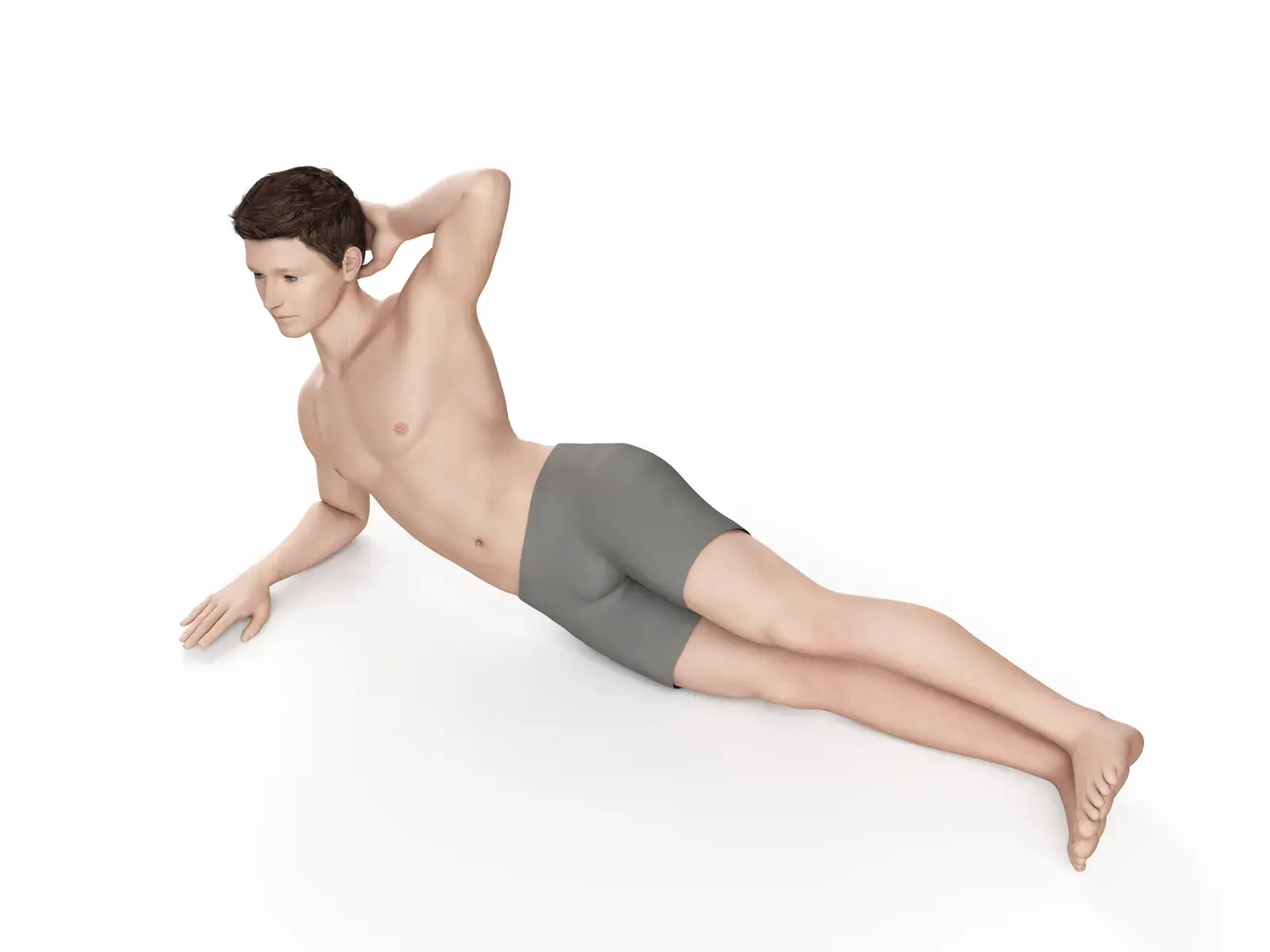
Why does the open book move the mid back rather than the low back?
Bending the knees up to hip height and keeping them stacked locks the pelvis and lumbar spine, so the turning has to come from the thoracic spine, which is built to rotate far more than the low back is. That is the whole design of the exercise: protect the lower segments, move the upper ones.
If your top knee slides back as the arm opens, the pelvis has rolled with you and the low back has taken over. Pinning the knee with your bottom hand, or resting it on a foam roller or a stack of pillows, keeps the rotation where it belongs. People with mid back pain often feel the stiffness right between the shoulder blades the first few times.
Who tends to get the most from an open book stretch?
People whose mid back has stiffened from long, still postures or one-sided sports usually notice the clearest change. A therapist decides whether stiffness is part of your problem by testing how far and how comfortably you turn in each direction.
- Hybrid and office workers who sit for hours on video calls; see physical therapy for desk workers.
- Golfers who want a fuller backswing turn without forcing it from the low back, a common goal as the season opens around Carmel in spring; see physical therapy for golfers.
- Swimmers and paddlers who need the chest to open for an efficient stroke.
- People with an ache between the shoulder blades, described in pain between the shoulder blades.
- People with neck pain whose stiff upper back makes the neck do extra turning.
What should you feel during the open book, and what should you not?
You should feel a broad stretch across the chest and the front of the top shoulder, plus a gentle turning sensation through the middle of your back. You should not feel a pinch at the front of the shoulder, pain in the low back or tingling into the hand.
A pinch at the front of the shoulder usually means the arm is opening too high or too far behind you; lower it toward hip level or bend the elbow and lead with it instead. Tingling into the hand can mean a nerve in the arm does not like the position, which is worth telling a therapist about rather than pushing through. Breathing out as you open usually lets the ribs turn a little further than holding your breath does.
Which open book variations suit sore shoulders or stiff hips?
A bent-elbow version, with the top hand resting behind your head, is kinder to sore shoulders; a quadruped version called thread the needle suits people who cannot lie on their side comfortably. A therapist picks the version and how long to hold each turn.
| Variation | What changes | Why it might be chosen |
|---|---|---|
| Hand behind the head, elbow leads | Shorter lever on the shoulder | The straight-arm version pinches the front of the shoulder |
| Pillow under the head and between the knees | Neck and hips supported | Side-lying is uncomfortable for the neck or hips |
| Top knee on a foam roller | Pelvis held still more firmly | The knee keeps sliding back as you rotate |
| Thread the needle on hands and knees | Rotation against gravity, one arm reaching under | Lying on the side is not possible or the goal is more control |
| Half-kneeling rotation with a stick | Upright and more sport-like | Golf, throwing or racquet sports are the goal |
How to do the open book stretch, step by step
Lie on your side
Lie on one side with a pillow under your head. Bend your hips and knees to roughly a right angle and stack the knees together.
Line up the arms
Reach both arms straight out in front of your chest at shoulder height, palms together, like a closed book.
Anchor the knees
Rest your bottom hand on your top knee, or rest that knee on a roller, so the knees stay together throughout.
Open the book
Breathing out, sweep the top arm up and over toward the floor behind you, letting your eyes and head follow the hand. Go only as far as the chest turns comfortably.
Pause and return
Pause for a slow breath in the open position, then bring the arm back to close the book. Repeat on the same side, then turn over for the other side.
Skip the stretch and get checked if
- You have chest pain, tightness or breathlessness, especially with effort: that needs medical care, not stretching.
- Your shoulder has dislocated before and opening the arm behind you feels unstable.
- You have osteoporosis or a past spinal compression fracture and have not asked a clinician about twisting movements; see the osteoporosis-safe exercise guide.
- Mid back pain wakes you at night, comes with fever or unexplained weight loss, or followed a fall.
If you think it is an emergency, call 911.
