
Frozen shoulder physical therapy in Carmel, Indiana
Frozen shoulder, or adhesive capsulitis, is a thickening and tightening of the shoulder joint capsule that passes through freezing, frozen and thawing stages over many months. Physical therapy in Carmel is matched to the stage: gentle, pain-guided motion and sleep strategies while it is freezing, then progressively firmer stretching and strengthening as it stiffens and thaws. It often works alongside steroid injections or other care from your physician, and most people regain much of their motion over time.
At a glance
Common signs of frozen shoulder
Also called: Adhesive capsulitis, Frozen shoulder syndrome, Periarthritis of the shoulder, Stiff shoulder.
Why does a shoulder freeze without an injury?
In frozen shoulder, the capsule that surrounds the ball-and-socket joint becomes inflamed, then thickens and contracts, leaving less room for the joint to move. Why it starts is not fully understood, and for many people there is no injury at all.
According to AAOS OrthoInfo, it most commonly affects people between 40 and 60, women more often than men, and people with diabetes are at substantially higher risk and tend to have a longer, stiffer course. Thyroid disease, a period of immobilization after an injury or surgery, and some other medical conditions also raise the risk.
Frozen shoulder is different from a rotator cuff problem. With a cuff problem, someone else can usually lift your arm further than you can lift it yourself; with a frozen shoulder, the joint is stiff whether you move it or someone else does. That distinction is a key part of the shoulder pain examination.
Which stage is my frozen shoulder in, and how does that change treatment?
The stage is judged mostly by how painful the shoulder is compared with how stiff it is. OrthoInfo describes freezing as lasting about 6 weeks to 9 months with increasing pain and loss of motion, frozen as about 4 to 6 months where pain may ease but stiffness stays, and thawing as about 6 months to 2 years of gradual return.
A physical therapist measures your active and passive motion in each direction, notes where pain appears in the range, and asks about night pain and how the shoulder has changed over recent weeks. Because the stages overlap and do not have sharp edges, treatment is adjusted to how irritable the shoulder is on the day, not to a calendar.
In a painful freezing shoulder, forceful stretching tends to provoke more pain and does not speed recovery. In a stiff, less painful shoulder, firmer and more sustained stretching becomes useful. Getting that dose right is a large part of what a therapist adds.
Expect the therapist to repeat the same handful of measurements every few visits: how high you can raise the arm, how far it turns outward with the elbow at your side, and how far your thumb reaches up your back. Those numbers, rather than how a single day feels, show which stage you are moving through and when the plan should shift.
- Freezing: pain is the main problem; gentle range work, pain relief strategies and sleep positions
- Frozen: stiffness is the main problem; sustained stretching and joint mobilization added
- Thawing: motion is returning; strengthening and real-life reaching tasks take priority
What do frozen shoulder sessions look like in a private suite?
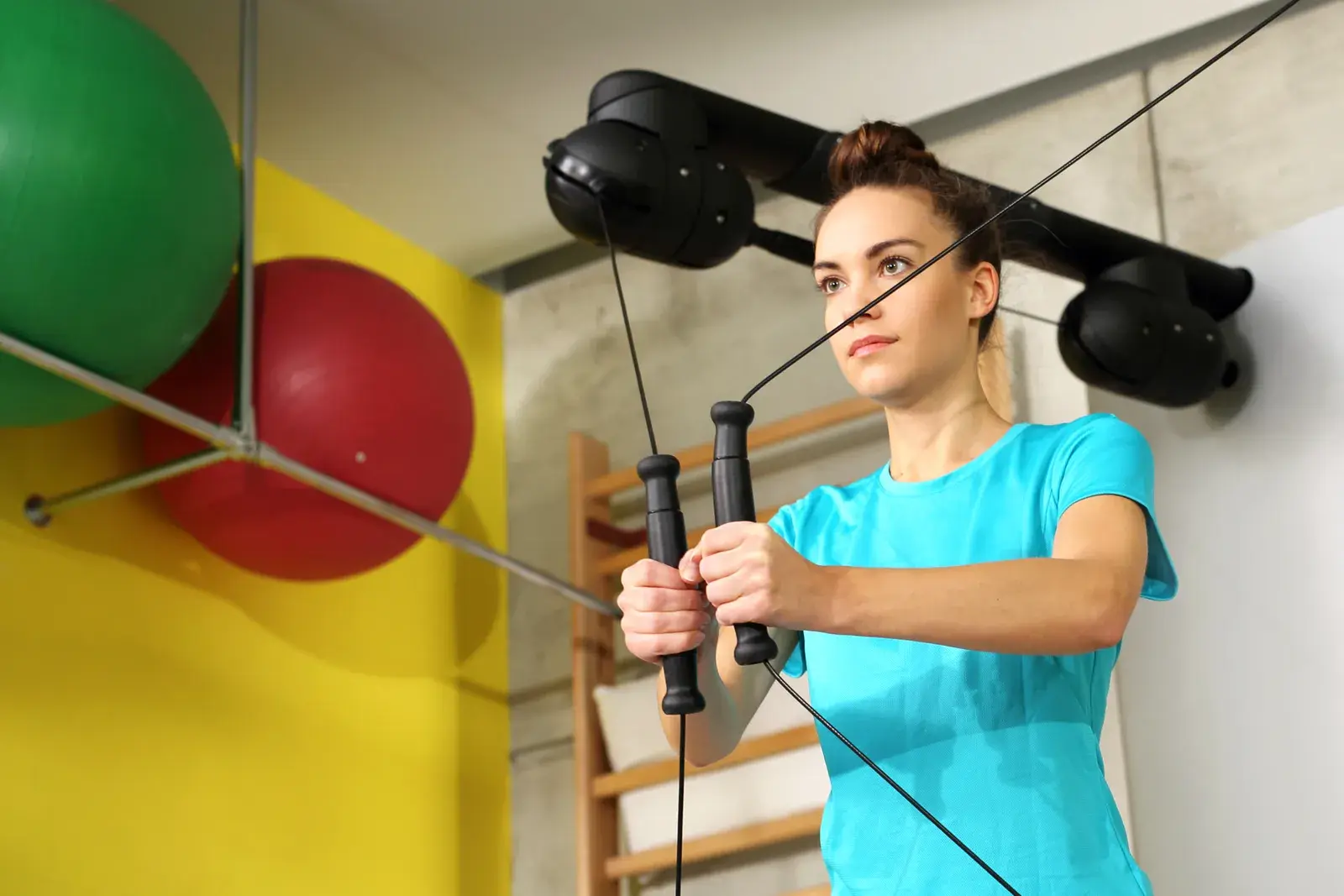
Sessions combine hands-on joint mobilization, stretching you can repeat at home, and strengthening for the muscles around the shoulder blade and rotator cuff. One-on-one time in a private suite at FlexWerk lets a therapist in the network adjust the dose minute by minute, and the cable column, dowels and bench make it easy to progress.
Typical exercises include pendulums, table slides, dowel-assisted flexion and outward rotation, sleeper and cross-body stretches, and reaching up a wall. As the shoulder thaws, band and cable work for rotation and the shoulder wall slide help connect the new range to strength.
Many physicians offer a steroid injection into the joint early on, which can ease pain and make exercise more comfortable. If a shoulder stays very stiff despite a full course of conservative care, a surgeon may discuss manipulation under anesthesia or an arthroscopic capsular release, followed by intensive rehab; the post-surgical rehabilitation page explains that phase.
- Gentle passive and active-assisted range work
- Joint mobilization targeted at the tight part of the capsule
- Home stretching, several short sessions a day rather than one long one
- Rotator cuff and shoulder blade strengthening as pain allows
- Practice of daily reaches: seat belt, high cupboard, hair, bra clasp or back pocket
Can physical therapy shorten the 1 to 3 years a frozen shoulder can last?
Physical therapy cannot promise a shorter course, but it often reduces pain, improves function sooner and helps people regain more motion than they would by waiting. Without treatment, OrthoInfo notes the whole process can last up to three years, and some people keep a degree of stiffness.
A typical plan involves weekly or every-two-week visits over a few months, with the home program carrying most of the progress between sessions. People with diabetes should expect a longer timeline. Visits may be spaced further apart during the long frozen stage, when steady home stretching matters more than frequent appointments. Even in the thawing stage, exercise helps you use the motion you are regaining, especially overhead strength for lifting and sport.
For more detail on duration, read how long frozen shoulder lasts. Your therapist will tell you honestly if progress stalls and you should see a physician about injections or other options.
How do I sleep and get through the day with a painful frozen shoulder?
For sleep, lie on your back or the opposite side with a pillow supporting the painful arm, so it rests slightly away from your body and the shoulder is not pulled across. Avoid lying on the affected side until the night pain settles.
During the day, keep using the arm for light tasks below shoulder height and avoid sudden, unguarded reaches, which tend to cause sharp jolts. Drivers on US-31 or Keystone Parkway may find it easier to steer with the other hand at the top of the wheel and to keep the seat belt within easy reach. Heat before your exercises often helps, and a few minutes of gentle movement several times a day works better than one long stretching session.
If you suspect frozen shoulder, the two-minute shoulder questionnaire is the quickest way to start. The matching team reads it, proposes a therapist in the network, and the therapist’s office confirms benefits before your first visit.
When to see a physician or go to the ER first
Physical therapy is the right start for most frozen shoulder. These symptoms are different and need medical attention before, or instead of, a physical therapy visit:
- Shoulder pain after a fall with an inability to lift the arm, which may be a fracture or dislocation
- Left shoulder or arm pain with chest pain, shortness of breath or sweating: call 911
- Fever, a hot, red, swollen shoulder or feeling unwell
- Unexplained weight loss or a history of cancer with new shoulder pain
- Numbness or weakness spreading down the arm
If you think it is an emergency, call 911.
Two-minute assessment
Get your frozen shoulder looked at
Tell us how your frozen shoulder started, how long it has been going on and what it is stopping you from doing. The matching team proposes a therapist in the network who focuses on it, and you hear back, usually within one business day.
- No referral needed to start in Indiana (first 42 days)
- We check which therapists work with your plan before you book
- One-on-one care in a private suite at Carmel City Center
How therapists treat it
Kinds of care used for frozen shoulder
- Orthopedic physical therapyExercise-led care for back, neck, shoulder, hip, knee and ankle problems, delivered one-on-one in a private suite.
- Manual therapyHands-on joint and soft-tissue treatment that eases stiffness so the exercise part of your plan can do its job.
- Post-surgical rehabilitationProtocol-led rehab after joint replacement, ligament, tendon and spine surgery, in a quiet private room instead of a crowded gym.
Questions
Frozen shoulder: what people ask
Information on this website is general education, not medical advice, a diagnosis or a treatment plan. Only a licensed clinician who examines you can advise on your condition. If you may be having a medical emergency, call 911.
Something we did not cover? Ask the matching team or ring (888) 353-9975.
Is frozen shoulder linked to diabetes?
Yes. People with diabetes are much more likely to develop frozen shoulder, and it is often stiffer and slower to resolve. Good blood sugar control is part of the overall plan.
Can a frozen shoulder come back?
Recurrence is uncommon, though AAOS OrthoInfo notes it can come back, especially when a contributing factor such as diabetes is still present. Keeping both shoulders active and strong is sensible.
Should I push through pain when stretching a frozen shoulder?
Not in the painful freezing stage. Mild stretch discomfort that settles within an hour or so is fine; sharp pain that lingers into the night means the dose was too high.
Do I need an MRI for a frozen shoulder?
Usually not. Frozen shoulder is diagnosed mostly from the history and examination, though a physician may order an X-ray to rule out arthritis. Imaging is used when something does not fit the pattern.
Is a steroid injection better than physical therapy?
They are often used together rather than as alternatives. An injection can ease pain in the early stage, which makes exercise more tolerable, while therapy addresses stiffness and strength.
Why does my frozen shoulder hurt more at night?
Lying down changes the pressure in and around the joint, and you lose the distraction of the day. The shoulder pain at night page covers positions and other causes.
Google reviews
What guests say about FlexWerk
These are live Google reviews of FlexWerk at Carmel City Center, the private-suite facility where therapists in the network practise.
Related
Conditions that travel together
 Shoulder painOne-on-one care for impingement-type pain, frozen shoulder, instability and overhead sport shoulders.
 Rotator cuff injuryProgressive loading for cuff tendinopathy and tears, plus protocol-led rehab after surgical repair.
 Shoulder arthritisMotion and strength work for glenohumeral osteoarthritis, to manage pain, delay surgery or prepare for a replacement.
Page reviewed By the Monon Therapy Collective editorial team

Carmel City Center · Carmel, Indiana
Start with a conversation
Tell us what hurts and what you want to get back to. We will tell you honestly whether a therapist in the network is likely a good fit for what you describe, and match you with an independent, licensed therapist who is. Only that therapist can assess what will help.
885 Monon Green Blvd, Suite 120, Carmel, IN 46032 · Monday to Friday 5 AM to 9 PM · Saturday and Sunday 7 AM to 4 PM