Often, yes, for pain, strength and daily function, though it cannot rebuild lost cartilage. The American Academy of Orthopaedic Surgeons gives exercise and patient education its strongest recommendation for knee osteoarthritis, and that applies to severe cases too. How much a knee improves depends more on strength, motion and how the joint is loaded than on the X-ray alone. If a fair trial does not make daily life manageable, a knee replacement remains an option, and the strength built in therapy helps that recovery.
Last reviewed By the Monon Therapy Collective editorial team
What does “bone on bone” really mean on a knee X-ray?
It means the joint space has narrowed so much on the X-ray that the cartilage between the thigh bone and shin bone appears worn away in at least one part of the knee. OrthoInfo describes arthritic knee X-rays as showing joint space narrowing, bone changes and bone spurs. It is the severe end of osteoarthritis, often graded as the highest level on the scales radiologists use.
The phrase sounds final, but it describes a picture taken standing still. It does not measure how strong your thigh muscles are, how far the knee bends, or how well you walk, and those are the things that drive how the knee feels on a given day. Two people with similar X-rays can have very different levels of pain and activity, which is why the image alone does not decide what you can do.
What can physical therapy change when the cartilage is gone?
Physical therapy cannot grow new cartilage, but it can change almost everything around it. Stronger quadriceps and hip muscles absorb load that would otherwise land on the joint, better knee extension makes walking less effortful, and a graded plan teaches the knee to tolerate more activity again.
The evidence for this is unusually strong. The AAOS guideline for managing knee osteoarthritis without joint replacement rates supervised exercise, unsupervised exercise or aquatic exercise over no exercise as a strong recommendation for pain and function, and rates patient education programs as strong as well. Manual therapy added to exercise gets a limited rating, so hands-on work is a helper, not the main event.
What does a therapy program for severe knee arthritis include?
A program for a bone-on-bone knee is built on strength and activity, adjusted so the knee settles between sessions. A physical therapist examines your knee first, then sets the starting level, so the list below is a description of common parts, not a plan to follow on your own.
Many therapists use a simple pain rule: some discomfort during exercise is acceptable if it stays moderate and settles by the next morning. That approach lets you build strength without waiting for pain to vanish, which on a severely arthritic knee it may never fully do. Losing weight, if that applies to you, carries a moderate AAOS recommendation and makes every step lighter for the joint.
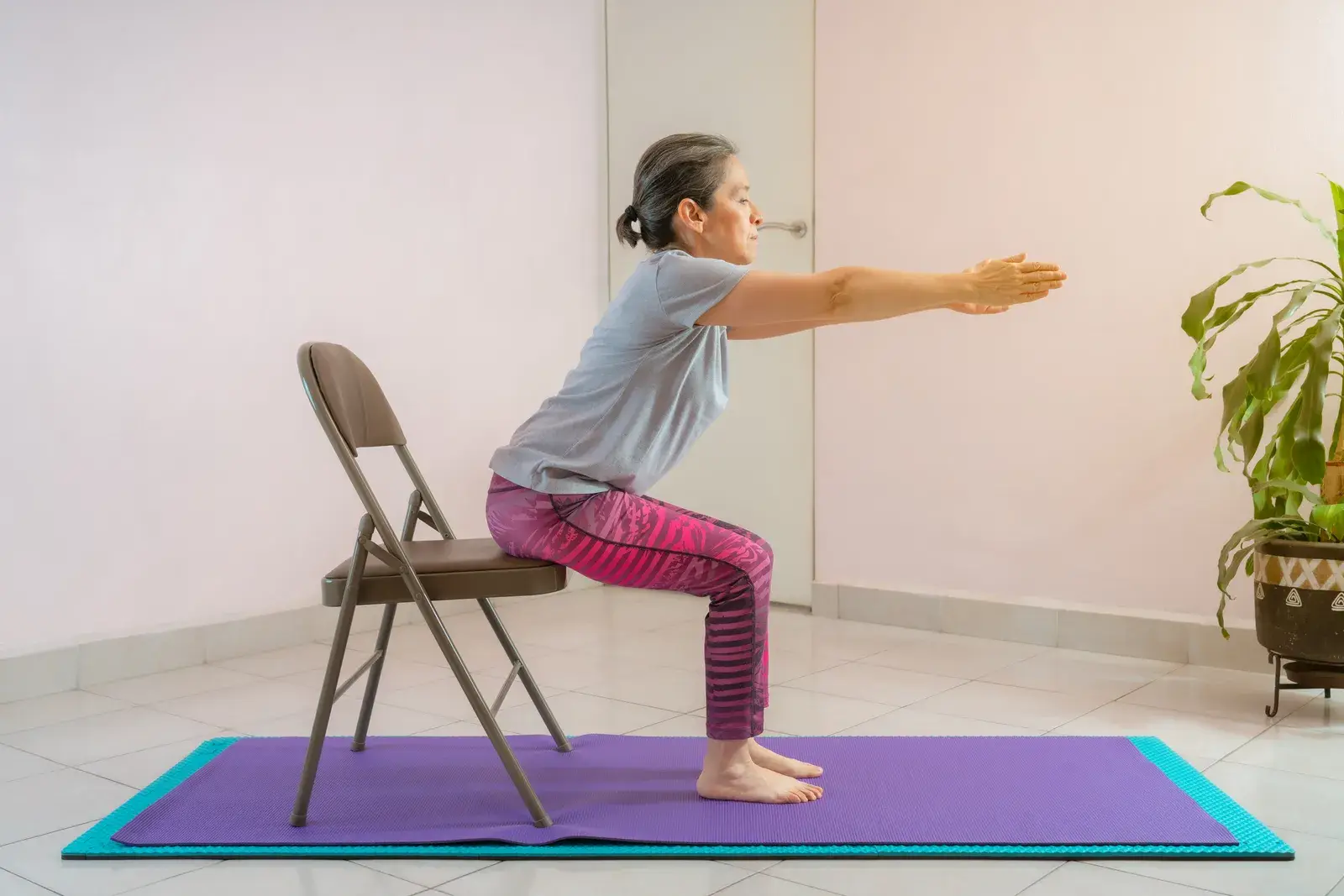
- Quadriceps and hip strengthening, often with sit-to-stand practice, step-ups and machine work
- Range of motion work to keep the knee as straight as possible, since a bent-knee walk is tiring
- Walking or stationary cycling at a dose the knee tolerates, built up week by week
- Balance practice, because an arthritic knee and a weak leg raise the risk of falls
- Advice on bracing, footwear and pacing, including whether a knee brace makes sense
How long should I try physical therapy before considering a knee replacement?
Long enough for strength to change, which takes weeks to a few months rather than a handful of visits. Muscles need repeated, progressive loading before they get meaningfully stronger, so judging the result after two sessions tells you very little. Agree on two or three measurable goals at the start, such as stairs, a walking distance or getting up from a low chair, and review them together.
Surgery becomes the stronger option when pain wakes you at night most nights, when the knee limits basic daily tasks despite steady work, or when the joint is visibly deforming. That choice is one you make with an orthopedic surgeon, ideally after a fair trial of strengthening. If you do go ahead, time spent in prehab before joint replacement is not wasted: people who arrive at surgery stronger tend to find the first weeks of rehab easier.
Can I keep walking the Monon Trail or playing pickleball with a bone-on-bone knee?
Often yes, with adjustments. Walking is one of the activities a therapist will usually try to protect, and the flat, paved Monon Trail through Carmel is a forgiving surface for building distance gradually. The question is dose: how far, how often, and how the knee responds the next day.
Pickleball and golf put more twisting and quick stops through the knee, so a therapist looks at your movement and strength before suggesting how much to play. For a fuller picture of treatment options, see knee osteoarthritis physical therapy in Carmel, or start the knee questionnaire and the matching team will propose a therapist in the network who works with arthritic knees.
Related questions
Will exercise make a bone-on-bone knee wear out faster?
Guideline evidence supports exercise for knee osteoarthritis, and well-dosed strengthening is not thought to speed up wear. A therapist adjusts the load if your knee stays more swollen or painful the next day.
Do cortisone shots help a bone-on-bone knee?
They can ease pain for a period, but OrthoInfo notes the effect does not last indefinitely and doctors often limit them to three or four a year per joint. Many people use that window to make progress with exercise.
Is cycling a good choice for an arthritic knee?
Often, because it moves the knee through a range without impact. Our answer on cycling with knee pain covers seat height and how to build up.
Do I need a referral to see a physical therapist for knee arthritis in Indiana?
Not for the first 42 calendar days of treatment under Indiana law, though some insurance plans still require one for payment.
What signs mean I should see a doctor first?
A hot, red, very swollen knee, fever, a knee that suddenly cannot bear weight, or calf pain and swelling all need a physician promptly rather than a therapy appointment.
Keep reading
- Can physical therapy help me avoid surgery?
- Is cycling good for knee pain?
- Should I wear a knee brace?
- Knee osteoarthritis physical therapy in Carmel
- Prehab before a joint replacement
- Orthopedic physical therapy in Carmel
Sources
This page is general education, not medical advice. A physical therapist can only advise on your situation after an examination.
